

The Three Questions I Took From Soundtracks And Why I Recommend This Book

Hi, it’s Diana from We Get Better with Age, and I’m continuing my series on books I’ve read and genuinely enjoyed.
This time I’m sharing Soundtracks, The Surprising Solution to Overthinking by Jon Acuff, a book that gets at something so ordinary and so pervasive that most of us hardly notice it anymore. We live inside a steady stream of repeated thoughts about ourselves, our relationships, our bodies, our future, our work, our families, and what is or is not still possible. Some of those thoughts help us move through life with courage and clarity. Others quietly drain our energy, narrow our choices, and leave us stuck in patterns we mistake for personality. Acuff calls those repeated thoughts “soundtracks,” and once I had that language for them, I started hearing them everywhere.
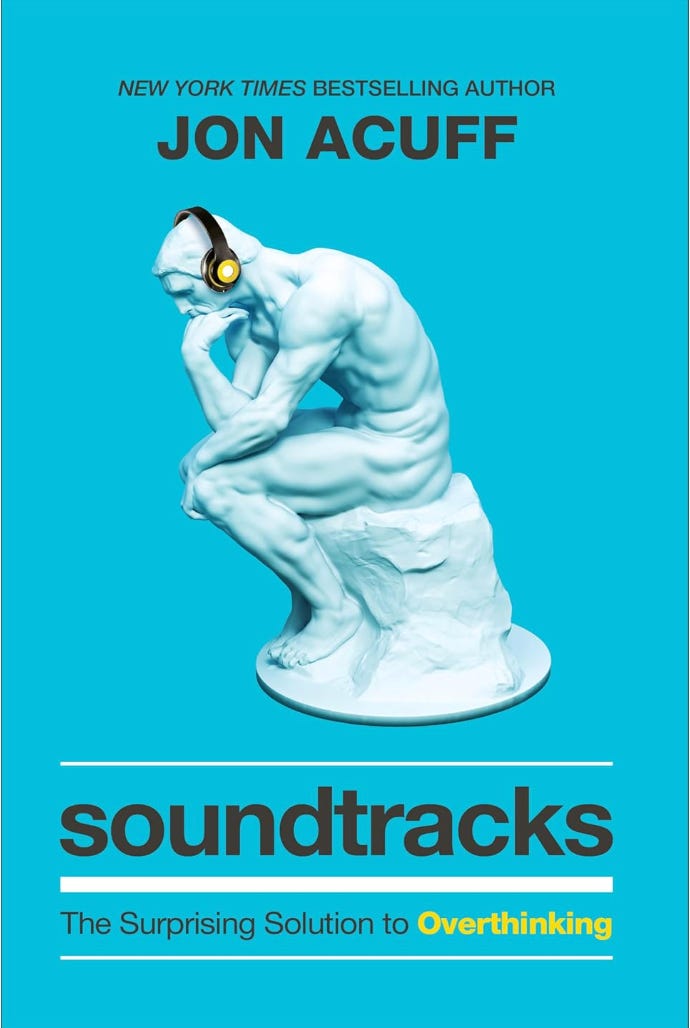
What I appreciate most about this book is that it takes a familiar experience, overthinking, and reframes it in a way that feels both compassionate and useful. On the official book pages, Acuff describes overthinking as “the sneakiest form of fear,” something that steals time, creativity, and goals while disguising itself as realism or caution. He is not arguing that we should become less thoughtful people. He is arguing that many of us are spending enormous amounts of mental energy replaying thoughts that are inaccurate, discouraging, or simply no longer serving us, and that a better life begins with noticing what is playing on repeat in the background of our minds
That idea landed hard for me, partly because it explains so much with such surprising elegance. So many of the things we struggle to change are not blocked first by circumstance. They are blocked by a sentence. A sentence we have heard ourselves think for years. A sentence we have repeated often enough that it now feels less like an opinion and more like a fact.
I am too old for that now.
It is too late to change.
My best years are behind me.
I always do this.
There is no point trying.
Nobody wants to hear from me.
Those sentences do real work in a life. They influence whether we take care of ourselves, whether we ask for help, whether we reach out to people, whether we begin again after disappointment, whether we keep participating in our own lives with curiosity and hope, or whether we slowly begin shrinking them.
Enjoying this? Plus members get exclusive Sunday deep-dives, a printable 60-page Fun Pack every month, and full library access. $10/month or $97/year.
The Central Idea: We Become the Thoughts We Keep Rehearsing
Acuff’s central argument is clear. Overthinking is not a permanent character trait. It is a habit of thought, and habits of thought can be challenged, edited, and replaced. The publisher description summarizes the book’s method in three simple steps, retire your broken soundtracks, replace them with new ones, and repeat them until they become as automatic as the old ones. That structure is a big part of what makes the book work. It does not leave you admiring an idea from a distance. It gives you a way to use it.
I think that is why Soundtracks fits so naturally beside the other books I have written about in this series. Oliver Burkeman’s Four Thousand Weeks asks us to face the finiteness of time honestly and choose what our lives are actually for. Katy Milkman’s How to Change helps explain why behavior change is so difficult and how we can make it more achievable. Dr. Gladys McGarey’s The Well Lived Life reminds us that vitality, purpose, movement, and love remain available throughout the whole of life. Acuff is working at the level underneath all of that. He is helping us listen to the private narration that accompanies our time, shapes our choices, and either keeps us moving or quietly persuades us to stop.
And in that sense, this is not really a book about overthinking alone. It is a book about inner atmosphere. About the emotional climate inside a life. About whether the voice we hear all day long is one that expands us, steadies us, and tells the truth, or one that keeps pushing us toward fear, withdrawal, resignation, and self criticism.
The Soundtracks We Rarely Question
One of the most striking things about broken soundtracks is how rarely they arrive sounding obviously broken. The most persuasive ones often sound sensible. They sound like maturity. They sound like caution. They sound like hard won wisdom. That is what gives them power.
A thought such as “I should be realistic” can hide a deeper message that says, “I should stop hoping.”
A thought such as “I do not want to bother people” can hide a deeper message that says, “I should not need anyone.”
A thought such as “I cannot do what I used to do” can quietly slide into, “I should stop trying altogether.”
That is where the book becomes especially useful. It interrupts the authority of familiar thoughts. It asks us to stop treating every repeated sentence as if it has earned permanent residence in our minds. A thought can be familiar and still be false. A thought can contain a grain of truth and still distort the whole picture. A thought can sound practical while doing enormous damage.
I think many of us, especially as we get older, have inherited soundtracks from all kinds of places. From family. From work. From old disappointments. From illness. From caregiving. From a culture that glorifies youth and treats aging as a story of steady diminishment. Over time, those messages can settle into the background of the mind and start shaping identity.
That is why I found this book so clarifying. It treats inner language as something we can examine instead of simply obeying.
The Three Questions That Change Everything
One of the most useful ideas associated with Soundtracks is the simple test Acuff gives for evaluating the thoughts that play in our minds. You just need to answer these three questions:
Is it true?
Is it helpful?
Is it kind?
I love this test because it is so disarmingly direct. It cuts straight through the vague haze of emotion and gets to the question underneath. Does this thought deserve to stay.
The first question, is it true, helps expose fear dressed up as fact. Many of our most discouraging thoughts crumble as soon as we examine them carefully. “I always fail” is almost never true. “Nobody cares” is almost never true. “It is too late for anything meaningful” is not a fact. It is an interpretation.
The second question, is it helpful, is equally powerful. A thought may contain partial truth and still be leading us somewhere unhelpful. “This is harder than it used to be” may be true. If it leads to “so I will adjust and keep going,” it may even be helpful. If it leads to “so I should quit,” it has become a trap. Helpfulness is about direction. Where is this thought taking you.
The third question, is it kind, may be the most revealing of all. So many of us speak to ourselves in tones we would never use with another human being. We call it honesty when often it is simply harshness. We call it realism when often it is hopelessness. Kindness, in this framework, is not softness or self indulgence. It is accuracy without cruelty. It is truth spoken in a way that leaves room for dignity, effort, and hope.
One Example of How the Test Works
Take a soundtrack many people hear at some point, especially around health, aging, or personal reinvention.
“It is too late for me to change.”
At first glance, that thought can feel wise. It can feel grounded. It can feel like the conclusion of experience. But let’s put it through the three questions.
First, is it true.
Usually, no. It may be true that change looks different now than it did twenty years ago. It may be true that change takes more intention, more patience, or more support than it once did. It may be true that some doors have closed. But “it is too late for me to change” is far too absolute to be honest. People change habits, strengthen relationships, rebuild health, discover purpose, make new friends, learn new skills, and reshape the emotional tone of their lives in every decade.
Second, is it helpful.
Again, no. Even if the thought feels protective, it leads nowhere good. It discourages effort before effort has begun. It turns uncertainty into surrender. It invites passivity, which then gets mistaken for proof. If you believe it is too late, you stop acting. When you stop acting, life narrows. Then the narrowed life seems to confirm the original belief.
Third, is it kind.
Clearly not. You would never look at someone you love and say, “It is too late for you to become stronger, wiser, more connected, more peaceful, or more alive.” You would not hand that sentence to a friend. You would not offer it to a parent. You would not say it to someone recovering from loss or trying to begin again. There is no reason it deserves a place in your own mind either.
So what replaces it.
Something truer. Something more useful. Something kinder.
A replacement soundtrack might be, “Change is still available to me, even if it asks for patience.”
Or, “This season of life still belongs to me, and I can begin from here.”
Or, “I do not need perfect conditions to make meaningful change.”
Those sentences feel very different in the body. They create movement. They leave room for action. They open a door.
That is the point of the exercise. You are not replacing a hard truth with a pretty lie. You are replacing a distorted thought with one that reflects reality more fully.
Retire, Replace, Repeat
What makes Soundtracks especially practical is that Acuff understands insight alone rarely changes anything. Most of us have moments of clarity. We underline the passage. We have the realization. We say, yes, that is exactly what I do. Then, twenty-four hours later, we are back inside the same old thought loops.
That is why repetition matters so much here.
Broken soundtracks became powerful through rehearsal. They were repeated so often that they started to sound official. They moved from possibility to certainty simply because they were familiar. New soundtracks need their own repetition if they are going to become believable enough to shape behavior.
This is where the book connects beautifully with Milkman’s work on behavior change. We often think change begins with a perfect plan or a burst of motivation. More often, it begins with a thought that makes action feel imaginable again. If the soundtrack in your head says, “I never follow through,” then every new effort begins under a cloud. If the soundtrack says, “I can learn to do this differently,” the same effort begins on different ground.
And this is where it also connects with Burkeman’s Four Thousand Weeks. If our time really is finite, then the voice narrating that time deserves closer attention than most of us give it. We can lose a great deal of life to inner commentary that is frightened, repetitive, and needlessly cruel. We can also reclaim a surprising amount by changing the sentences we keep rehearsing.
Why This Book Matters
What I admire about Soundtracks is that it takes the invisible seriously. It acknowledges that the private conversation inside a person’s mind is not small. It shapes energy. It shapes courage. It shapes whether we reach out or withdraw, begin or postpone, trust or assume defeat.
For a culture increasingly fluent in therapy language and productivity language, this book offers something simpler and, in some ways, more humane. It asks us to become better witnesses to our own thoughts. To notice what is playing. To test it. To stop handing authority to sentences that are false, unhelpful, or unkind. And then, patiently, to build something better in their place.
That is why I think this book belongs in a series about getting better with age. The older we get, the more important it becomes to examine the story we are telling ourselves about what this stage of life means. Are we narrating decline alone. Are we rehearsing limitation before it arrives. Are we mistaking fear for wisdom. Are we speaking to ourselves without tenderness. Those questions shape more than mood. They shape the life that follows.
Your Turn
After you read Soundtracks, I would encourage you to try one small exercise.
Write down one thought you have heard yourself repeating lately. Just one. A sentence that shows up when you feel anxious, discouraged, guilty, ashamed, or uncertain.
Then ask it three questions.
Is it true?
Is it helpful?
Is it kind?
If the answer is no, retire it.
Then write a better sentence. One that is more honest. More generous. More useful. One you would be glad to hear someone you love say to themselves.
As always, I would love to hear what you are reading, and what ideas are staying with you. If this book speaks to you, write back and tell me what soundtrack you are replacing. I read everything.
Until next time, please pay attention to what is playing in your mind. Those thoughts shape more of a life than we tend to realize.