Four Thousand Weeks — What's Your Number?
Hi, it’s Diana from Healthy Seniors, and I’m continuing my series on books I’ve read and enjoyed.
This time I’m sharing Four Thousand Weeks: Time Management for Mortals by Oliver Burkeman. The title stopped me the first time I saw it. Four thousand weeks — where does that number come from?
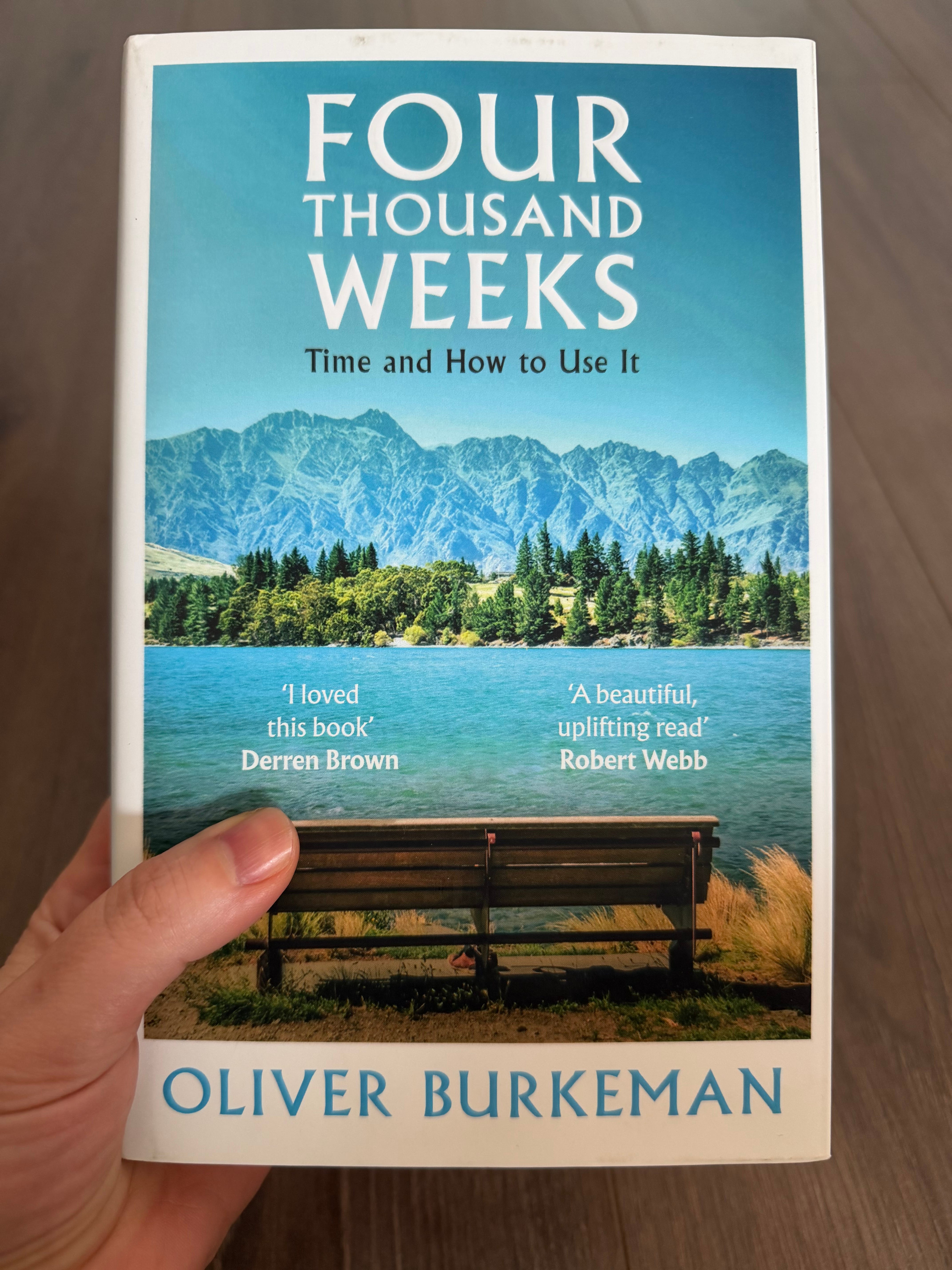
It’s simple, and a little startling once you do the math. The average human life lasts roughly 80 years. Multiply that by 52 weeks, and you get just over four thousand weeks. That’s it. That’s a whole life, laid out in weeks rather than years. Somehow the weeks make it feel more real than the years do — more countable, more concrete, more finite.
I sat with that number for a while. And then I did the math I suspect many of you will do too: at 60, or 70, or 80, four thousand weeks is not your number anymore. Your number is smaller. Much smaller.
And I’ll be honest about why this landed so personally for me. Both of my parents are turning 80 this year. And quietly, in the back of my mind — the way you don’t always say things out loud but you feel them — I’ve been sitting with a question I suspect many of you know well from one side or the other: how much good time do we have left together? Not time in the abstract. Real time. Quality time. The kind where everyone is present and well and glad to be in the same room.
I don’t have an answer to that. Nobody does. But it’s the question that made me reach for this book, and it’s the question that stayed with me all the way through it.
Burkeman is a journalist who spent years writing about productivity before arriving at a conclusion that surprised him: the entire project of trying to get on top of everything, to optimize every hour, to finally reach some imaginary state of “done” — it was making him miserable. And it wasn’t working. He set out to understand why, and what he found changed the way he thinks about his days.
His argument — gently, honestly, and without any trace of sentimentality — is that facing our finitude clearly is not a reason for fear. It’s a reason to choose. To stop deferring. To decide, on purpose, what the remaining weeks are actually for.
That’s what I needed to hear. Maybe you do too.
The Central Idea: You Will Never Get It All Done — And That’s the Point
Burkeman’s central argument is one that I think many of us in our later years already sense, even if we’ve never heard it stated quite so plainly: you are never going to get everything done. Not because you’re not trying hard enough. But because it is genuinely impossible, for anyone, at any age, under any circumstances.
There will always be more to do than time to do it. More people to call than hours in the day. More books to read, more places to see, more conversations to have. That gap never closes. And the sooner we stop treating it as a personal failure and start making peace with it, the sooner we can direct our attention to what we’ve actually chosen — and be fully present for it.
If you have lived long enough to lose people you love — and many of you have — this isn't abstract philosophy. You know, in a way that's hard to put into words, that time is not a given. You've stood at bedsides and gravesides and come home to a quiet house and understood it in your body: this is finite. All of it.
Burkeman says that understanding is not a burden. It is, if we let it be, the beginning of clarity.
The “Someday” Problem
This is the section of the book I keep coming back to, and the one I most want to press into your hands. I actually wrote about this on Sunday.
Most of us have a someday list. Not a written one, necessarily — just a collection of things we’ve been meaning to get to. The trip we’ve been putting off. The old friend we’ve been intending to call. The hobby we set aside years ago and always assumed we’d return to. The conversation we’ve been waiting for the right moment to have.
Burkeman is gentle, but he is honest: someday is not a day of the week. And at this stage of life, the window for some of those things is narrowing — not because of illness, necessarily, but because deferral itself becomes a habit. We get so comfortable with the idea of doing something that the thought of it starts to feel like a substitute for the thing itself.
I’ve thought about this a great deal since reading the book. How many of us have been carrying something on our someday list for five years? Ten? How many of those things, if we’re honest with ourselves, are we still waiting for the “right” moment — when we feel better, when it’s less complicated, when life settles down a little?
Burkeman’s message, and I think he’s right, is that life will not settle down. The settling has to come from us. We have to decide, deliberately and on purpose, that now is when we do the thing. Not because we’re running out of time in a frightening way — but because now is when we’re alive, and alive is when things happen.
If loneliness has crept in — and for many of you it has, especially after losing a spouse or a close friend — this is exactly where it matters most. The friend you’ve been meaning to call. The neighbor you’ve been thinking about inviting for coffee. The grandchild you’ve been hoping to have a real conversation with, not just a holiday visit. These are not small things to get to eventually. They are, as I’ve written about before, among the most important things you can do for your health and your happiness. Don’t save them for someday.
You Already Know This
Here’s what I want to say to those of you who have been reading Healthy Seniors for a while: a lot of what Burkeman writes, you already know. You’ve lived it.
You know that the things you remember most from your life are almost never the tasks you completed or the obligations you met. They’re the afternoons that stretched out unhurried. The conversations that went on longer than planned. The moments when you were fully present with someone you loved and you both knew it.
You know that busyness is not the same as aliveness. You know that productivity is a means, not an end. You know, somewhere deep down, that the years when you were most relentlessly busy were not necessarily the years you’d choose to live again.
What Burkeman does is take what you already know and give you permission to act on it. To stop apologizing for moving more slowly. To stop filling every hour because an empty hour feels vaguely like failure. To let some things go undone without guilt, because they were never the point anyway.
That permission, for a generation raised to work hard, stay busy, and earn every rest — is not a small thing.
Attention: The Gift We Keep Giving Away
Burkeman writes beautifully about attention — where we direct it, who competes for it, and how rarely most of us are truly present in the moment we’re actually in.
His observation is pointed: we are at dinner while thinking about tomorrow’s appointment. We are on a walk while replaying a conversation in our heads. You are with the grandchildren while part of you is somewhere else — distracted by worry, by background noise, by the mental to-do list that never quite quiets.
The result, he says, is that we are not fully present for large portions of our own lives. We’re always in transit — moving through now to get to some future moment when we’ll feel settled enough to really show up.
For those of us who have lost people we loved, this hits differently. We know what it means to wish, afterward, that we had been more present. More attentive. Less distracted by things that didn’t matter. We know the specific ache of realizing we were somewhere else during a moment we can’t get back.
Burkeman isn’t prescribing meditation or any particular practice. He’s making a simpler, harder ask: choose to be where you are. Let this conversation, this meal, this view from the window, this quiet morning be enough. Not because you’ve given up on more — but because you’ve decided that this, right here, counts.
For me, reading this while thinking about my parents, it was a reminder I needed. When I’m with them, I want to actually be with them. Not half-present, not distracted, not already thinking about what comes next. Just there, in the room, paying attention. Because those afternoons are the ones I’ll want to remember.
“Cosmic Insignificance Therapy”
This is my favorite idea in the book, and it sounds stranger than it is.
Burkeman proposes something he calls cosmic insignificance therapy — the deliberate practice of reminding yourself how small you are in the sweep of history and time. Not as a reason for despair, but as a source of genuine relief.
In the grand scheme of things, the chore you’re dreading doesn’t matter much. The household task that’s been nagging at you, the obligation you feel guilty about not meeting, the standard you’ve been holding yourself to without quite knowing why — none of these are, at the scale of the universe, particularly significant.
What this frees up is permission. Permission to spend an afternoon doing something that brings you joy, without justifying it as useful. Permission to let some things stay undone because they simply aren’t worth the hours. Permission to rest without earning it first.
For a generation that learned to equate worth with productivity, that equated stillness with laziness, that felt vaguely guilty about pleasure that hadn’t been worked for — this is quietly revolutionary. You don’t have to earn your afternoon. You don’t have to justify your walk, your book, your phone call, your hour in the garden. You can simply choose it, because you want to, because it matters to you, because your weeks are finite and this is one of them.
Choosing What to Let Go
One of the most freeing sections of the book deals with what Burkeman calls deliberate neglect — the conscious choice to let certain things get less of you, so that the things that matter most can get more.
We will always be neglecting something. The only question is whether we do it on purpose or by accident. Most of us neglect by accident: the loudest, most urgent things crowd out the quieter but more important ones. The difficult phone call gets delayed while we handle easier tasks. The walk doesn’t happen because something else filled the hour. The visit gets put off again.
Deliberate neglect means deciding in advance what your non-negotiables are — and protecting them, even when other things press in. For many of us, those non-negotiables look like this: the daily walk. The regular call with a close friend. The medical appointments we actually keep. The time with family that we stop rescheduling. Guard those fiercely, and give yourself genuine permission to let lesser things slide.
This is not giving up. It is, at last, getting your priorities in the right order.
Grief, and What It Teaches Us About Time
I want to say something that Burkeman touches on but that I think deserves more space for our community.
Many of you have experienced profound loss. A spouse of 40 or 50 years. A sibling. A close friend who understood you in ways no one else quite does. And grief, among the many things it is, is also a teacher about time — about what we did with it, and what we wish we had done differently, and what we intend to do with whatever remains.
Burkeman writes that our finitude, honestly faced, is not the tragedy we fear. It is what gives our choices weight. A life with unlimited time would have no stakes. It is precisely because our weeks are numbered that how we spend them matters.
I don’t think this erases grief. I don’t think it’s supposed to. But I do think it offers something real to those of us who have stood at a loss and wondered what to do next with our days. The answer Burkeman points toward is not to fill the time frantically, or to shut down and wait. It is to choose — carefully, deliberately, with full knowledge of what choosing means — how to spend the time that is ours.
Why This Book Matters
I've thought a lot about why this book lands so differently depending on where you are in life. At 47, I still carry some illusions about time — the sense that there's a long runway ahead, that I'll get to things eventually. But reading this alongside my parents turning 80, I could feel the difference. For them, and perhaps for you, the question isn't someday anymore. Many of you have already done the things you were supposed to do — raised families, built careers, met obligations — and now the question is genuinely open in a way it may not have been before: what do I actually want? What Burkeman offers isn't a new truth for someone who has lived that long. It's a framework for finally acting on the truth you've been carrying for years.
Dr. Gladys McGarey, who lived to 103 and had a ten-year plan at 102, wasn’t trying to do everything. She was doing the specific things that made her feel alive. That’s the whole idea, held in one extraordinary life.
As for me — I'm going to call my parents this week. Not to check in quickly, not while I'm doing something else, but just to talk. To be there. To pay attention. Because that's what this book reminded me to do, and I suspect it will remind you of something similar.
Your Turn
After you read Four Thousand Weeks, I’d encourage you to do just one thing: write down three things you’ve been saving for someday. Not tasks. Not obligations. Three things that genuinely matter to you — a person you’ve been meaning to reach, an experience you’ve been deferring, a way of spending your time that feels important and keeps getting crowded out.
Then ask yourself honestly: what would it take to do one of them this month?
The weeks are counting. Make some of them count back.
As always, I’d love to hear what you’re reading. What books on time, meaning, and living well have stayed with you? Leave a comment or write back — I read everything.


I’m reaching out because your writings and posts align closely with my new book, The Second Act Advantage. It explores how people in their 40s–70s can monetize their experience, stay relevant in an AI-driven world, and build a purpose-filled second act. The unique twist: it’s the first book ever released with a free, custom-built AI companion app, trained on my work to act as a personal mentor for readers.
Given your audience’s interest in wellness, practical reinvention and future-focused living, I think this could make a compelling post or feature. Millions are about to lose their jobs to AI and I wrote this book to help people prepare and then thrive.
If you’re interested, I’m happy to share a review copy, demo the AI companion, or tailor insights specifically for your readers. jayalansamit@gmail.com
Much to think about! I am going to go look for this book. Thank you for sharing this.