
Making Your Home Work: The Front Door and Entry

We’ve covered the bathroom and some kitchen tools. You voted for the entryway and stairs next. So here’s the first part. The stairs are coming next, and more rooms after that.
This article covers getting in and out of your home. The front steps, the front door, the threshold, the entry zone just inside. These are moments you move through multiple times every day, often carrying something, sometimes in the dark or the rain, and the environment either helps or it doesn’t.
Picture this….
You came home after dark last week. You found your key on the third pocket you checked, in the dim light of the porch. You fumbled the lock twice before it opened. You stepped over the threshold, the one that’s slightly higher than it looks, and caught yourself on the doorframe.
Nothing happened. You were fine.
But you stood there for a moment with your hand still on the frame, and you thought: this is a lot of work just to get into my own house.
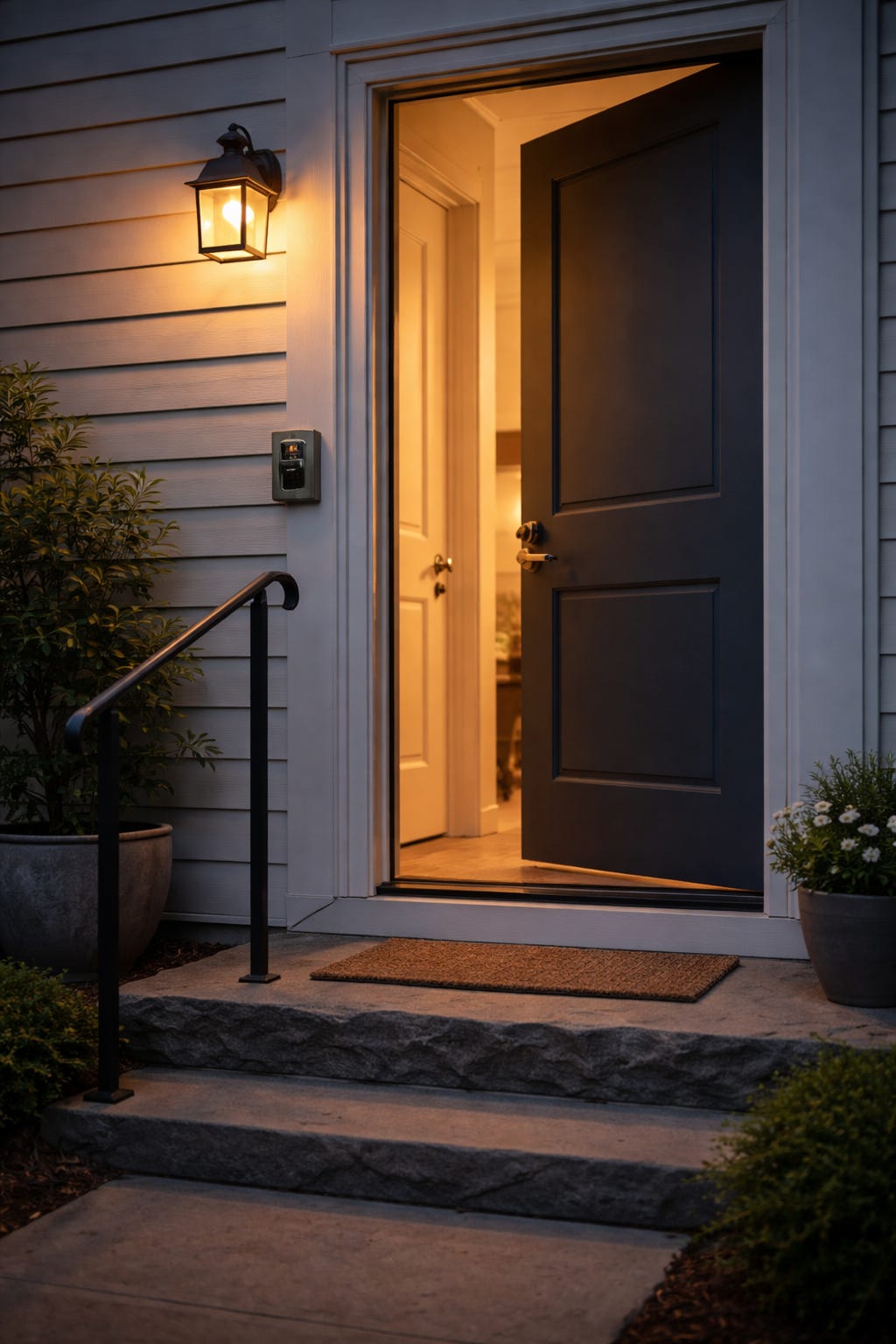
These moments are not crises. They’re friction. Small, daily friction that accumulates into something that changes how you move around your home, and eventually how much you move at all. Most of the changes below cost under $100. Several cost under $30. None require a contractor. Most can be done in an hour on a weekend morning with basic tools, or with no tools at all.
*A note on product links: The links throughout this article help you see what these products look like and the features to consider. They’re not specific endorsements, just helpful starting points. You’re free to find similar products locally or from other retailers. If you purchase through these links, we may earn a small commission at no cost to you.
An Outdoor Handrail for Front Steps
The problem: Most front entries have one to four steps between the ground and the door. Most of those steps have no handrail at all. This is a detail nobody notices when they’re thirty. At sixty or seventy, those same steps are navigated differently in rain, in the dark, carrying grocery bags, or on an icy morning.
The front steps are also the place where guests, delivery drivers, and anyone visiting your home has to navigate. A handrail there protects everyone.
The solution: A wall-mounted or ground-mounted outdoor handrail sized for your number of steps. These are adjustable, powder-coated to resist rust and weather, and install with concrete anchors or lag bolts into a wood frame in under an hour.
Examples to look for:
Signstek Handrails for Outdoor Steps, 2-Step Kit — Powder-coated wrought iron, adjustable 0 to 30 degrees to match your step pitch, waterproof and rustproof, 4.5 rating
Signstek Handrails for Outdoor Steps, 3-Step Kit — Same system for 2 or 3 steps, 4.5 rating, all hardware included for concrete or wood mounting
VEVOR Handrails for Outdoor Steps, 29” Wall Mount — 530 lb load capacity, wall-mounted U-shape design, burr-free surface, suitable for porch, deck, and front entry steps
What to look for: Powder-coated or galvanized finish (resists outdoor weathering), adjustable angle to match your actual step pitch, installation hardware for both concrete and wood (most entry steps are one or the other), load rating above 250 lbs.
Why this matters: You probably carry groceries in from the car several times a week. Both hands full, front steps to navigate, and the only thing stopping a slip is your own balance. An outdoor handrail means you put one hand on it and carry whatever you’re carrying with the other. Rain doesn’t change the equation. Dark doesn’t change the equation. A heavy bag doesn’t change the equation. Those three steps between the ground and your front door become three ordinary steps rather than a moment that requires attention every single time.
A Non-Slip Mat at the Entry
The problem: The mat you step onto when you come through the front door, if you have one, is probably old. The rubber backing has hardened and cracked. It slides on hard floors when you step on it, which is arguably more hazardous than no mat at all. And if it’s a thick mat, the edge itself is a tripping hazard for a foot that doesn’t clear it fully.
The exterior mat, the one outside the front door, gets wet. When it’s wet and someone steps on it, it slides on the concrete. You’ve seen it move.
The solution: A low-profile, non-slip mat with rubber or natural rubber backing, both inside and outside the front door. Low-profile means no raised edge to catch a toe. Waterproof means it stays flat when wet rather than curling. Easy to clean means you actually replace it when it wears out.
Examples to look for:
OLANLY Front Door Mat, Indoor Outdoor, Waterproof — Natural rubber backing, ultra-thin low-profile design slides under doors, fade resistant, easy to clean, 4.3 rating, 11,300+ reviews
GORILLA GRIP WeatherMax Doormat, Natural Rubber, Indoor Outdoor — Waterproof, stain and fade resistant, stays flat in all weather, spot clean with damp cloth or hose off outdoors, multiple sizes available
What to look for: Low profile under 0.5 inches so it doesn’t create its own trip hazard, natural rubber backing rather than synthetic (higher grip, holds position better on smooth floors), drainage texture on the surface for outdoor use, easy to clean and quick to dry when worn.
Why this matters: The mat that slides when you step on it with wet shoes is the mat that will slide the day you step on it carrying something and can’t catch yourself. A new, properly gripping mat is one of the cheapest changes on this list and one of the most immediate. You step on it and it doesn’t move. That’s the whole change. It sounds like a small thing, and it is, until the day it isn’t.
An Entryway Bench
The problem: Putting shoes on and taking them off requires bending, balance, and a free hand. You’re standing on one foot. Or you’re sitting on the floor, which requires getting back up. Or you’re doing the half-squat thing while holding the wall. None of these is comfortable, and none is as easy as it used to be.
The entryway is also where people stand when they first come in, where bags get dropped, where mail accumulates. If there’s no dedicated place to sit, you’re doing all of this standing, with one hand on whatever is closest.
The solution: A bench at the entry, at a height that lets you sit down with your feet flat on the floor and stand back up without straining. With storage underneath or in compartments so shoes have a designated place and aren’t spread across the floor as tripping hazards.
Examples to look for:
HOOBRO Shoe Storage Bench with Cushion, 39.4” — 12 open cubbies for shoes, padded cushion seat, coat rack included, holds up to 330 lbs, industrial style that suits most entryways
HOOBRO Entryway Bench with Flip-Open Storage — More compact at 32.3 inches, hidden storage under cushion, good for smaller entries
What to look for: Seat height between 17 and 19 inches (standard chair height, easiest to sit and stand from), shoe storage below so footwear is off the floor, cushioned seat, weight capacity well above your body weight, size appropriate for your entryway without blocking the door swing.
Why this matters: You might have been putting shoes on while holding the doorframe. Or sitting on the stairs, which puts you at a difficult height to stand from. Or skipping shoes entirely on short trips because the whole process has become more trouble than it’s worth. An entry bench means you sit down, put both shoes on with both hands, and stand up from a proper seat height. You stop treating the act of getting ready to leave your house as a physical challenge.
A Grab Bar Near the Front Door
The problem: The front door is where you’re in motion. You’re stepping in or out, managing a bag or an umbrella, transitioning between the threshold height difference, reaching for the key or the handle. It’s a moment of imbalance built into a daily routine.
In the bathroom article, we covered grab bars for the shower and toilet. The same principle applies here: a fixed, solid point to hold during a moment of transition.
The solution: A wall-mounted grab bar near the interior side of the front door. Or a fold-down grab bar that stays flush against the wall when not in use and swings out when you need it.
Examples to look for:
APDTEK Flip Up Grab Bar for Doorway, Fold-Down — Folds flat against the wall when not in use, 300 lb capacity, non-slip textured grip, suitable for both doorways and steps, all mounting hardware included
Moen Home Care 18” Stainless Steel Grab Bar — The same grab bar from the bathroom article works just as well here, 4.7 rating, ADA compliant, concealed screw design
What to look for: ADA-compliant load rating (250 lbs minimum), mounted into studs or solid blocking rather than just drywall, position at a height your hand reaches naturally when standing, non-slip textured surface.
Installation note: Same rule as the bathroom: studs or solid blocking, not drywall alone. If there’s no stud where you need the bar, a handyman can install blocking inside the wall first.
Why this matters: The front door is used multiple times every single day. Every time you step over the threshold, reach for the lock, or manage bags while getting in or out, you’re doing it with no fixed support. A grab bar near the door means you have something solid to hold at the exact moment you need it most. You reach for it without thinking. It holds.
Threshold Ramps at Every Level Change
The problem: Most homes have at least one threshold with a lip: the front door frame, the transition from hardwood to carpet, the step up into the garage, the doorway between rooms with different flooring heights. These lips are typically half an inch to three-quarters of an inch tall. At speed, they’re invisible. At the end of the day, when your foot doesn’t quite clear them, they catch your toe.
Threshold injuries among older adults are consistently underreported because they don’t feel like falls. You catch yourself. You stumble. You blame yourself for not watching where you were going. But a half-inch lip is an environmental hazard, and removing it is a five-minute job.
The solution: Rubber or PVC threshold ramps that bridge the level change with a gradual slope instead of a sudden edge. Self-adhesive. No tools. Under $20 each.
Examples to look for:
EaseThrift Floor Transition Strip, 36-inch — Amazon’s Choice, 0.5 to 0.6 inch rise, self-adhesive, wood grain finish that blends with most floors, available in multiple lengths
LIEKUMM 5/8” Rise PVC Threshold Ramp, 36-inch — 1,700 lb weight capacity, durable PVC, self-adhesive backing, 36 inches wide, eco-friendly material
1” Rise Rubber Threshold Ramp, 40-inch — For larger threshold drops up to 1 inch, rubber construction, self-adhesive, 40 inches wide, suits walkers and wheelchairs
What to look for: Rise height that matches your actual threshold (measure it first), self-adhesive backing or included double-sided tape, material that won’t compress or crack under daily foot traffic, color or finish that blends with your floor rather than standing out as a hazard marker.
Why this matters: Walk through your home right now and count the threshold lips. Most people find three to six. Each one is a toe-catch waiting for a day when your foot is a centimeter lower than usual. Threshold ramps don’t just eliminate the hazard. They make every doorway transition feel smooth and deliberate. You stop navigating your own house in micro-steps of attention.
Lever Handles on Every Door
The problem: Round doorknobs require a twist-grip. You wrap your hand around the knob, grip firmly, and rotate your wrist. When your hands are full, that’s impossible. When your hands are wet from washing up before dinner, it’s slippery. When your knuckles are stiff from arthritis or a cold morning, it’s painful. And if the knob is old and the mechanism is stiff, you’re applying force at a wrist angle that your joints don’t appreciate.
The solution: Lever-style door handles. You push down or pull up on the lever, and the door opens. One finger is enough. A closed fist works. A wrist works. You can open the door with your elbow if your hands are full. They install in the same holes as your existing knobs.
Before you order, there are two types of interior lever, and you will need both. Passage levers have no lock mechanism at all. They are for doors that are never locked from inside: hallway doors, closet doors, the door between your kitchen and your living room. Privacy levers have a simple push-button lock on the inside and a small emergency release on the outside for situations where someone is locked in. They are for bathroom and bedroom doors. Walk through your home and count each type before you order so you get the right quantity of each. Both install the same way and take about five minutes per door.
Examples to look for:
Kwikset Casey Interior Passage Lever — For hallway and closet doors that don’t need a lock. Reversible for any door orientation, installs in existing holes with a screwdriver, Best Seller, 4.6 rating, 1,500+ reviews, available in satin nickel and matte black, around $22
Kwikset Halifax Interior Privacy Lever — For bathroom and bedroom doors that need a simple privacy lock. Push-button lock on the interior side, no key required, same easy installation, 4.7 rating, 875+ reviews, available in satin nickel and matte black, around $30
What to look for: ADA-compliant lever design (tested for ease of use with limited grip strength), finish matching your existing hardware, adjustable backset (fits standard door bore holes in either 2-3/8 or 2-3/4 inch), interior or exterior rating appropriate for the door’s location.
Why this matters: You’ve probably left an interior door open rather than deal with a stiff knob when your hands were full. Or twisted a knob with your forearm on a bad joint day. Lever handles mean none of that is a decision anymore. You approach a door, press the lever, it opens. You walk through with whatever you’re carrying. The door does what a door is supposed to do.
A Keypad Lock for the Front Door
The problem: Keys require finding them, extracting them from a pocket or bag, orienting them in the dark, inserting them precisely into a lock, and turning them. When your hands are cold, your grip is less reliable. When you’re carrying groceries, your hands aren’t free. When you’re hurrying because it’s raining or because you’re late, the fumble is more likely.
There’s also the secondary problem: if you ever lock yourself out, or if someone needs to get in to check on you, keys require physical exchange. Copies require trips to the hardware store. And if a key is lost, you’re changing locks.
The solution: A keypad deadbolt. You punch in a code. The door unlocks. No key to find, orient, or lose. You can set different codes for different people, change codes remotely or at the lock, and auto-lock behind you so you don’t have to check whether you locked up.
Examples to look for:
TEEHO TE001 Keyless Entry Door Lock with Keypad — #1 Best Seller in deadbolts, supports 20 access codes plus one-time guest codes, auto-lock adjustable from 1 to 99 seconds, anti-peeping code (enter random digits before your real code and it still unlocks), backlit keypad, comes with 2 backup keys, installs in about 30 minutes
Schlage Encode Smart WiFi Deadbolt — WiFi connected, works with Alexa and Google, create and delete codes from the app, see lock history, built by one of the most trusted lock manufacturers in the US
What to look for: BHMA Grade 2 or Grade 3 certification (graded security and durability), backlit keypad (works in the dark), auto-lock feature (locks itself after a set time), backup physical key option, weatherproofing if it’s an exterior door, battery life indicator so you’re not surprised.
Why this matters: The morning you stand on the porch with bags in both hands looking for your keys while it’s raining is not a hypothetical. It happens. A keypad means you approach the door, punch four digits with one finger, and walk in. That’s it. You can also give your adult children or a trusted neighbor a code for emergencies without cutting a key. You can delete that code when it’s no longer needed. The front door stops being a daily friction point and starts being a door.
A Video Doorbell
The problem: The doorbell rings. You’re in the kitchen, or upstairs, or settled into a chair. You don’t know who it is. It might be a delivery. It might be a neighbor. It might be someone you don’t want to open the door for. So you move quickly to get to the door before whoever it is leaves, which means moving faster than you’d otherwise choose to, which means less attention on the stairs or the hallway floor.
Rushing is when things go wrong.
The solution: A video doorbell that sends a notification to your phone when someone is at the door. You see who it is on your phone from wherever you are. You can speak to them through the phone if you want to. You can tell them to leave the delivery. You can decide not to answer. You go to the door on your own schedule, at your own pace, with full information.
Examples to look for:
Ring Battery Doorbell, Head-to-Toe Video, Latest Model — Ring’s best-selling video doorbell, battery-powered so no wiring required, head-to-toe video covers your full front step, two-way talk, motion detection with real-time phone alerts, works with Alexa
Ring Battery Doorbell Plus — Upgraded HD+ video with taller field of view, includes a quick-release battery pack for easy recharging without removing the doorbell, motion zones to reduce false alerts
What to look for: Battery-powered rather than wired (no electrician needed, installs with two screws), two-way audio so you can speak with visitors from your phone, motion detection with alerts before someone even rings the bell, HD video with a wide enough field of view to see the full entry area, works with your existing phone.
Note on subscription: Ring requires a paid subscription (currently $4.99 per month) to store and review video. The live view and real-time alerts work without a subscription. Decide whether the storage matters to you before purchasing.
Why this matters: The doorbell doesn’t just save you a trip. It gives you control over your own door. You decide, from wherever you are in the house, whether to answer, when to answer, and what to say. The delivery person doesn’t leave because you couldn’t get there in time. The uninvited visitor doesn’t get you to open the door. You move to the entry when you’re ready, not when you’re rushing. That shift, from reactive to deliberate, is worth more than the hardware.
Where to Start
Not every change here applies to your home. Pick what’s actually making your daily life harder right now.
If your front steps have no handrail, add one before winter. A wet or icy step with nothing to hold is genuinely dangerous.
If your entry mat slides when you step on it, replace it today. It is the cheapest fix on this list and takes thirty seconds.
If you put shoes on while standing and holding the wall, get an entry bench. Sit down. Put your shoes on. Stand up from a proper height.
If your threshold lips catch your toe, put a threshold ramp on each one. Costs less than $20 each and takes five minutes.
If you still have round doorknobs, replace them with lever handles. Your hands will thank you the first morning they’re stiff.
If you fumble your key at the front door, install a keypad lock. One of the most useful changes in this entire series.
If you rush to the door when the bell rings, add a video doorbell. Stop rushing. See who it is from wherever you are. Answer on your terms.
Pick one. Order it. Use it for a week. Then come back for the next one.
The grab bar near the front door should be higher on the list. That's the spot with a bag in one hand, a threshold underfoot, and a door swinging shut behind you. Most moving parts, zero support.
The threshold ramps are the quiet fix. Half an inch of lip between rooms, and the foot that cleared it ten thousand times doesn't clear it once. That's not a fall in anyone's chart. That's a stumble you blame on yourself. Except your gait shortens after. You start watching the floor instead of everything else.
Pick the thing that almost got you last month.
I most often enter and exit my house through the garage. I have a remote to open the garage door so no keys to fumble with. However, there are some worries that I do have, like is someone lurking in the darkness, ready to pounce once I pull in…. Are there security measures that you can comment on for those of us who come through garages?