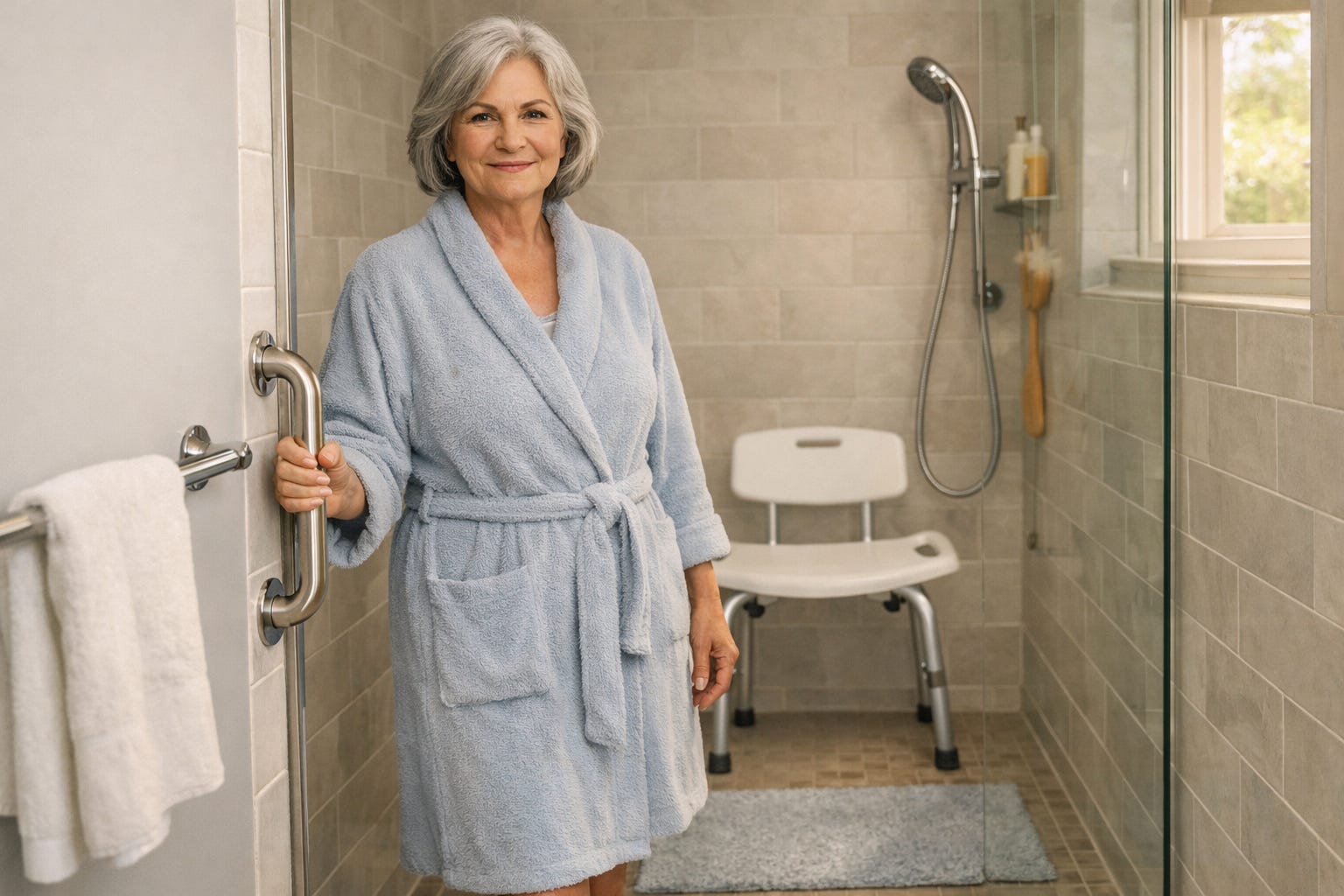
Five Simple Bathroom Changes That Prevent Falls
You stepped into the shower yesterday morning like you have ten thousand times before. The tile was wet. Your foot slipped, just half an inch. You caught yourself on the wall, but your heart was racing for the next twenty minutes.
You didn’t fall. Not this time. But you know it was close. And you’ve been thinking about it ever since.
Maybe you’ve started showering less often. Maybe you hold your breath every time you step over the tub edge. Maybe you’ve stopped taking baths entirely because getting out feels impossible.
Something shifts when you realize the bathroom, the place where you’re supposed to feel clean and refreshed, has become the room you approach with caution. When did that happen? When did this space that’s been part of your daily routine for decades start feeling dangerous?
I’ve been thinking about this a lot lately. Three-quarters of adults over 50 want to stay in their homes as they age. In the home they’ve built their life around, not in a facility, not with their kids. That’s the dream, and it’s entirely achievable.
But research shows that 9 in 10 homes aren’t currently ready to safely accommodate aging adults. And the room that needs attention first? Almost always the bathroom.
This December, my parents finally did something they’d been discussing for years. They replaced their old bathtub with a walk-in shower. I wrote about how that decision sparked a larger transformation in their home, how clearing out their bathroom for the renovation ended up changing far more than just one room.
But what struck me most was watching why they finally made that decision after years of hesitation.
It was the fear. The daily, quiet fear that lived in that bathroom.
Every morning, my mother would carefully lift one leg over the high tub edge while balancing on the other. Every evening, the same negotiation in reverse, this time when she was tired. Every single day, that moment of held breath, of careful placement, of hoping her balance wouldn’t fail her.
She’s a strong, independent woman who’s navigated far more difficult challenges in her life. But that tub edge had become her adversary. And she was tired of being afraid in her own home.
The bathroom is the most dangerous room in your home. It combines the two most hazardous elements: wet surfaces and hard edges. Approximately 235,000 people are injured in bathroom falls every year. That’s a packed football stadium full of people who slipped getting out of the shower, lost their balance stepping over the tub, or fell reaching for a towel.
Research shows that about half of people who’ve already fallen once haven’t made any modifications to prevent it from happening again. My parents didn’t want to wait for a fall to take action. They didn’t want the day when careful wasn’t enough.
The ideal solution, if your home allows it, is a walk-in shower. No step to navigate. No tub edge to lift your leg over. Just walk in, shower, walk out. My parents got theirs installed, and the relief is visible every time they use it. That daily negotiation with the tub edge is finally over.
But watching them prepare for and complete this renovation, and talking to contractors, occupational therapists, and other seniors who’ve made their bathrooms safer, I’ve learned something important:
You don’t need a full renovation to make your bathroom dramatically safer.
A walk-in shower is wonderful if you can do it. But it’s not the only answer, and it’s not always necessary or feasible for everyone’s situation.
Five strategic swaps exist that can reduce your fall risk by nearly 40%. These aren’t complicated renovations. They’re simple, proven modifications that work with your existing bathroom to make it safer, easier, and less frightening to use.
You can order most of them online this week. Install them this month. And immediately feel the difference in your confidence every single time you walk into that room.
My parents did the full renovation after planning it for years. But even with their new walk-in shower, they also installed grab bars, added a shower chair, and replaced their old bath mat.
Those additional changes? My mother told me they made just as much difference as the walk-in shower itself. The shower eliminated the step-over risk. But the grab bars give her something solid to hold. The shower chair means she can sit and relax instead of standing the entire time. The non-slip mat means she’s not sliding around.
All of it works together. And even if you can’t renovate, these five swaps alone can transform how safe and confident you feel in your bathroom.
If you’ve been thinking about making your bathroom safer but a full renovation isn’t possible right now, this is for you.
If you’re worried about falling but don’t know where to start, this is for you.
If you want to stay in your home for another decade or two and you know the bathroom is the biggest obstacle, this is for you.
Five swaps. Significant impact. Let’s walk through them.
A note on product links:
The links throughout this article help you see what these products look like and the features to consider. They’re not specific endorsements, just helpful starting points. You’re free to find similar products locally or from other retailers. If you purchase through these links, we may earn a small commission at no cost to you.
Swap #1: Install Grab Bars Where You Actually Need Them
The problem: You’re gripping towel bars, soap dishes, and shower curtain rods. None of these are designed to hold your weight. When you slip, they’ll come off the wall, and you’ll fall anyway, possibly with a metal bar hitting you on the way down.
The solution: Properly installed grab bars screwed into wall studs. They can hold 250-500 pounds. They give you something solid to grip when stepping into the shower, getting off the toilet, or steadying yourself.
Where to install them:
Inside the shower, vertically near the entrance
Horizontally along the back wall of the tub
Next to the toilet, on the side you transfer from
Outside the shower entrance for stepping in and out
Examples to look for:
Moen Home Care 24” Stainless Steel Grab Bar - Heavy-duty with concealed screws, 4.8 rating, 10,700+ reviews
Delta Faucet Contemporary 24” Grab Bar - Amazon’s Choice, modern chrome design, ADA compliant, 4.8 rating, 1,200+ reviews
Moen Home Care 18” Grab Bar - Shorter option for tighter spaces, 4.8 rating, 6,800+ reviews
What to look for: Stainless steel (won’t rust), textured or knurled surface (better grip when wet), concealed screw design (cleaner look), ADA-compliant (tested to support 250+ lbs).
Installation note: Grab bars MUST be screwed into wall studs or solid blocking, not just drywall. If you’re not confident installing them yourself, hire a handyman. A poorly installed grab bar is dangerous because you’ll trust it when you slip, and it won’t hold.
Why this matters: You might be using the towel bar to steady yourself when you step out of the shower. It’s held so far. But it’s screwed into drywall with two small screws. The day you actually need it, when your foot slips and you grab hard, it’ll rip out of the wall.
A grab bar installed into a stud means when you slip, you catch yourself. Your hand closes around cold steel. The bar doesn’t move. You don’t fall. It’s the difference between a close call and a broken hip.
Swap #2: Get a Shower Chair or Bench
The problem: Standing for ten minutes in a wet, slippery space. Balance gets worse when you close your eyes to rinse shampoo. Bending to wash your feet. Turning to reach the soap. Every movement is a potential fall.
The solution: A shower chair or bench. You sit down. Now washing your hair, soaping your body, and shaving your legs don’t require balancing on one foot on a wet surface.
Examples to look for:
HOMLAND Adjustable Shower Chair with Suction Feet - Bestseller, 400 lb capacity, adjustable height, 4.6 rating, 3,400+ reviews
Widened Shower Chair with Padded Back & Arms - Extra wide with padding, 400 lb capacity, 4.8 rating
Medline Shower Chair with Backrest and Padded Armrests - Professional medical-grade option, 350 lb capacity, 4.6 rating
Loyoda Transfer Bench with Swivel Seat - FSA/HSA eligible, pivoting arms, slides across tub edge, 350 lb capacity, 4.5 rating
What to look for: Adjustable height (to fit your tub/shower and your body), drainage holes in the seat (water doesn’t pool), rubber-tipped legs (won’t slip), backrest for support, armrests if you have trouble sitting/standing, weight capacity above your body weight.
Types to consider:
Basic stool: No back, lightweight, takes up minimal space
Chair with back: More support, comfortable for longer showers
Chair with arms: Easiest for sitting down and standing up
Transfer bench: Sits across the tub edge, lets you slide from outside to inside without stepping over
Why this matters: You might have stopped washing your hair in the shower because bending your head back with your eyes closed makes you dizzy.
A shower chair means you sit down before you start. You close your eyes to rinse shampoo, and you’re sitting. You lift one foot to wash it, and you’re sitting. The entire shower happens while you’re stable and secure. You’re not holding your breath waiting to finish before you lose your balance.
Swap #3: Add a Raised Toilet Seat (Especially with Handles)
The problem: The standard toilet is 15-17 inches high. Getting down is manageable. Getting back up requires strength in your legs, flexibility in your knees, and balance when you’re in the weakest position. If you can’t push yourself up smoothly, you’re at risk every time you use the bathroom.
The solution: A raised toilet seat adds 3-5 inches of height. Less distance to lower yourself. Less strength needed to stand back up. Models with handles give you something to push on, making standing easier and safer.
Examples to look for:
HOMLAND Raised Toilet Seat with Adjustable Handles - Bestseller, height AND width adjustable, 400 lb capacity, fits any toilet, 4.5 rating
Adjustable Toilet Seat Riser with Handles - Amazon’s Choice, adjustable height/width, padded seat, 4.5 rating
Carex E-Z Lock Raised Toilet Seat - 5” height boost, secure locking mechanism, 4.3 rating, 2,700+ reviews
What to look for: Height appropriate for your needs (3-6 inches available), handles/armrests for support, secure attachment system (clamps or locks to toilet), weight capacity over 300 lbs, padded seat (more comfortable for extended sitting).
Installation: Most clamp under the existing toilet seat or replace it entirely. No tools needed for most models. Takes 5-10 minutes to install.
Why this matters: You might have started avoiding going out because you’re worried about using unfamiliar bathrooms. You might be limiting fluids because every bathroom trip feels like a struggle. You might have fallen once already trying to stand up from the toilet, and now you brace yourself against the wall every time.
A raised toilet seat with handles means you lower yourself five inches instead of fifteen. When you stand, you push on the handles, using your arms to assist your legs. It’s stable. It’s secure. You stop dreading something you have to do ten times a day.
Swap #4: Use Long-Handled Bath Sponges and Brushes
The problem: Bending to wash your feet and lower legs. Twisting to reach your back. Balancing on one foot while washing the other. Limited flexibility and balance make basic hygiene difficult or impossible without help.
The solution: Long-handled sponges, brushes, and loofahs that extend your reach by 15-20 inches. You can wash your entire body while sitting on a shower chair or standing with both feet planted firmly.
Examples to look for:
LFJ 19” Long Handle Shower Brush Set - Amazon’s Choice, 3-in-1 design (brush, sponge, lotion applicator), 4.3 rating, 8,900+ reviews
Back Scrubber with Stiff and Soft Bristles - Bestseller, anti-slip handle, dual bristle options, 4.6 rating, 22,100+ reviews
What to look for: Handle length 15-22 inches, comfortable grip (textured or ergonomic), replaceable sponge heads, curved design (reaches back more easily), hanging loop for storage.
Types available:
Sponge on a stick: Soft, gentle, good for sensitive skin
Brush with bristles: More scrubbing power, exfoliating
Loofah handle: Natural exfoliation, middle ground between sponge and brush
Combination tools: Multiple attachments for different needs
Why this matters: You might have stopped bathing as thoroughly because you can’t reach your feet anymore. Or you need help from a spouse or caregiver for basic washing, which feels humiliating when you’re used to being independent.
A long-handled sponge means you sit on your shower chair, extend the handle down to your feet, and wash them without bending. You reach behind your back and scrub between your shoulder blades. You maintain your dignity and cleanliness without needing help from anyone.
Swap #5: Replace Slippery Surfaces with Textured Non-Slip Mats
The problem: Wet tile or porcelain tub surfaces become ice rinks. Water eliminates friction. You step carefully, but careful doesn’t matter when there’s no traction. One wrong shift in weight and you’re falling.
The solution: Textured rubber bath mats with suction cups that lock to the tub floor. Modern versions have hundreds of drainage holes so water doesn’t pool, and the textured surface gives your feet something to grip.
Examples to look for:
YINENN Extra Large Bath Mat 40”x16” - Bestseller, extra large coverage, machine washable, 4.4 rating, 52,500+ reviews
GORILLA GRIP Bath Mat 35”x16” - Bestseller, patented design, soft on feet, 4.5 rating, 109,100+ reviews
HITSLAM TPE Bath Mat 28”x15” - Amazon’s Choice, efficient drainage, soft TPE material, 4.4 rating
What to look for: Adequate size for your tub (measure before buying), strong suction cups (at least 100+), drainage holes throughout, textured surface (not smooth), machine washable, latex-free and mildew-resistant.
Sizes available:
Small: 16”x28” for shower stalls
Medium: 16”x35” for standard tubs
Large: 16”x40” for oversized tubs or extra coverage
Installation: Press firmly into clean, dry tub surface. Suction cups create seal. Lift and reposition as needed. Replace when suction weakens (typically 6-12 months).
Why this matters: Your current bath mat might be an old rubber mat from twenty years ago. The suction cups barely stick anymore. It slides around when you step on it, which somehow feels more dangerous than having nothing at all.
A new non-slip mat with 200+ suction cups doesn’t move. You step onto textured rubber that grips your feet. The hundreds of drainage holes mean you’re not standing in pooled water. Your feet stay planted. The mat stays exactly where you put it. You shower without that constant low-level fear of slipping.
Which Swap Should You Make First?
You don’t need to install everything at once. Pick the change that addresses your biggest safety concern:
If you’ve already had a close call or fall - Start with grab bars. They’re the most important safety feature and prevent the most serious injuries.
If standing in the shower exhausts or worries you - Get a shower chair first. It transforms showering from stressful to relaxing.
If getting off the toilet is a daily struggle - Install a raised toilet seat. It’s quick, inexpensive, and immediately makes bathroom use easier.
If you can’t reach to wash properly - Buy long-handled tools. They restore independence and dignity in personal hygiene.
If you’re worried about slipping every time you shower - Add a non-slip mat. It’s the easiest, fastest swap and provides immediate confidence.
Order one thing. Install it. Use it for a week. Notice the difference in your confidence, your safety, and your independence. Then decide what’s next.
What Should We Cover Next?
We’ve covered kitchen swaps and bathroom safety. Now we want to hear from you—what area of your home needs attention next?
Vote below and let us know what you’d like to see:
The topic with the most votes will be our next article. Help us create content that actually helps you stay safe and independent at home.


Maybe an article on products that enable seniors to carry their phones with them? A fall anywhere in the house could take a long time to resolve if your phone is on the coffee table and you're down the hall.
I already have all these elements in place but I still had a fall on the bathroom floor last year and sprained my ankle. Fortunately I always take my phone in the bathroom so I was able to call for help. If you live alone, that’s important.