

Five Kitchen Swaps That Can Make Cooking Easier

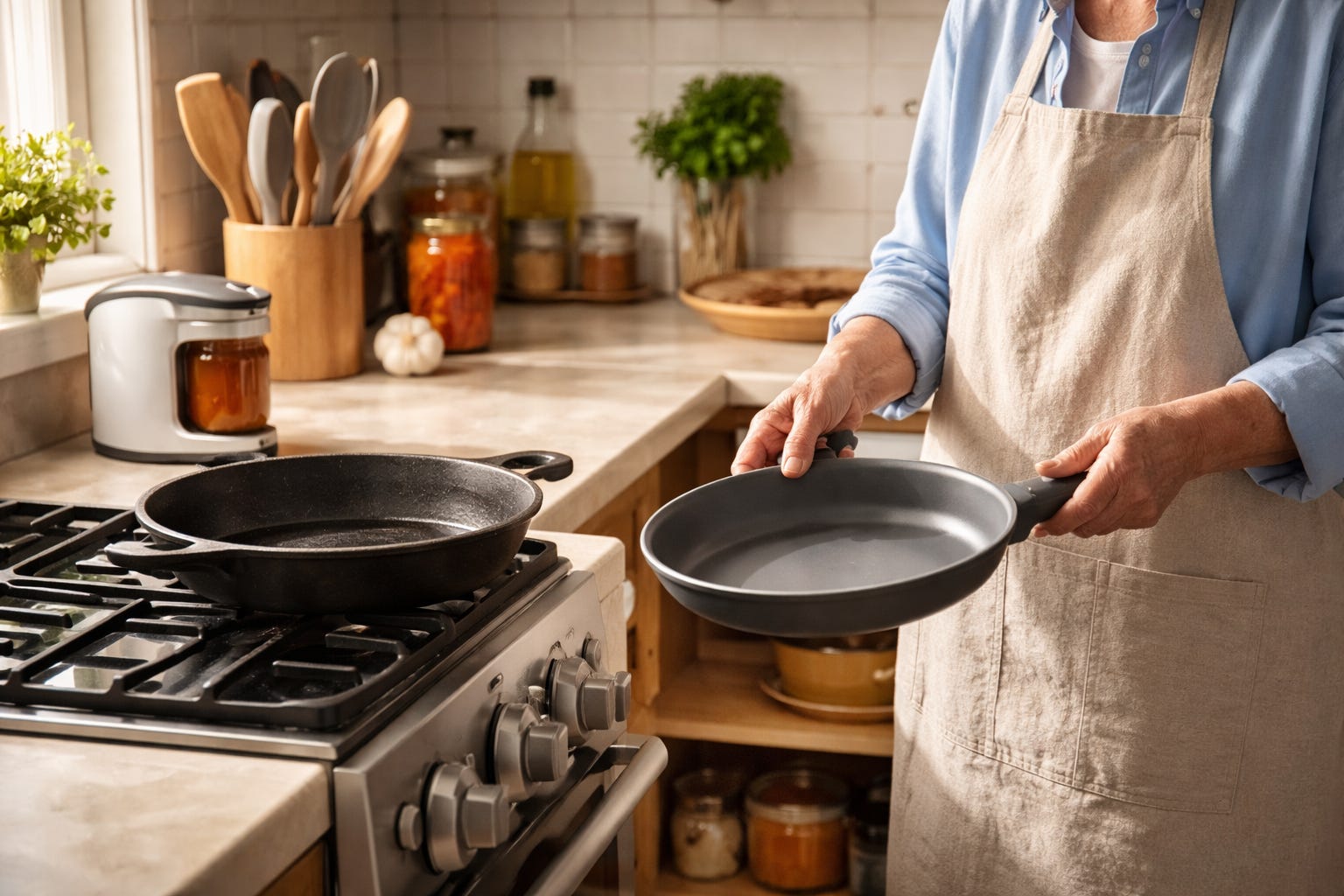
You bought the cast iron skillet forty years ago. It was your wedding gift, actually—heavy, indestructible, perfect. You’ve made thousands of meals in it.
This morning, you tried to move it from the stove to the counter. Just three feet. And your wrist gave that warning twinge. The one that says “not a good idea.” The one you’ve been ignoring for months.
You managed it. But you had to use both hands, and you had to brace yourself against the counter, and there was a moment where you thought you might drop it.
The skillet hasn’t changed. You have.
And now every time you reach for it, you hesitate. Which means you’re cooking less. Which means you’re eating more frozen dinners, more takeout, more things that don’t require the good pan.
Sometimes the things you love become the things that make life harder. The solution isn’t willpower or pushing through. The solution is admitting that what worked at forty doesn’t work at seventy, and making changes that let you keep doing what you love.
Your kitchen doesn’t need a remodel. It needs five strategic swaps. Small changes that make the daily work of feeding yourself manageable again.
A note on product links:
The links throughout this article are provided to help you see what these products look like and the kinds of features we’re referring to. They’re not specific recommendations—just a helpful starting point for your own research. You’re free to find similar products at local stores or other online retailers. If you do choose to purchase through one of the links, we may earn a small commission at no extra cost to you.
Swap 1: Heavy Cookware → Lightweight Alternatives
The problem: Cast iron skillets, heavy stainless steel pots, the Dutch oven that weighs twelve pounds empty. Wrist strength declines with age. Grip strength declines. A heavy pan full of boiling water isn’t just hard to lift, it’s dangerous if your grip fails.
The solution: Hard-anodized aluminum or ceramic-coated cookware. Modern lightweight options that heat evenly, don’t stick, and weigh a fraction of what you’re using now. A good lightweight skillet weighs about 2 pounds instead of 8.
Examples to look for:
T-fal Ultimate Hard Anodized Cookware Set - Complete lightweight set
SENSARTE Nonstick Ceramic Frying Pan with Lid - Single lightweight pan to start with
Nonstick Baking Sheet Pans - Good weight distribution
You don’t have to replace everything at once. Start with the one pot or pan you use most often.
What to look for: Weight under 3 pounds for skillets, comfortable handles, oven-safe if you use your oven, non-stick coating that actually works.
Why this matters: Maybe you’ve kept your cast iron because it was your mother’s. That’s understandable. But you can buy a lightweight 10-inch skillet for everyday use and keep the cast iron in your cabinet. You make eggs in the lightweight pan every morning. You can lift it with one hand. You can wash it without straining your wrists. The cast iron is still there—you’re just not forcing your body to wrestle with it every day.
Swap 2: Struggling With Jars → Automatic Jar Opener
The problem: Running the lid under hot water. Tapping the edge with a knife. Using a dish towel for grip. Arthritis makes grip strength inconsistent. Some days you can open the jar. Some days you can’t. You’re avoiding foods you like because the packaging is difficult.
The solution: An electric jar opener that sits on your counter. You press the jar against it, push a button, and it twists the lid off for you.
Examples to look for:
Robo Twist Electric Jar Opener - Adjustable for different lid sizes
Kitchen Mama Auto Electric Can Opener - Also opens cans and bottles
Why this matters: If you live alone, you might have stopped buying salsa, pickles, or pasta sauce—anything in a jar with a tight lid. You find yourself staring at the spaghetti sauce jar, trying to decide if it’s worth the struggle. Usually it isn’t. An electric jar opener means you stop negotiating with jars. You stop avoiding foods you like. You stop feeling incompetent every time you can’t get the pickle jar open.
Alternative: If an electric opener feels like too much, try a multi-opener tool with different-sized grips for jar lids, bottle caps, and pull tabs. Fits in a drawer and helps with most opening tasks.
Swap 3: Deep Cabinets You Can’t Reach → Pull-Out Shelves or Turntables
The problem: Storing things in the back of cabinets and never seeing them again. Buying duplicates because you forgot you already have it. Getting on your knees to reach into bottom cabinets. You’re using about a third of your kitchen storage, and the rest might as well not exist.
The solution: Pull-out shelf organizers for base cabinets. Lazy Susans for corner cabinets. Tiered shelf risers for upper cabinets. These aren’t renovations—they’re things you buy and install yourself (or have someone install in an afternoon).
Examples to look for:
Pull-out shelves:
Pull out Cabinet Organizer - Slides in, simple installation
Professional Pull out Cabinet Organizer- Heavy-duty sliding shelf
Lazy Susans:
Turntable Organizer - Simple turntable with raised edges
2 Tier Lazy Susan Turntable Organizer - Two-tier option
Shelf risers:
Expandable Kitchen Cabinet Shelves Organizers - Adjustable width
Why this matters: You might have a corner cabinet you can’t reach into. Anything that goes in there is effectively gone forever. You might find three unopened jars of peanut butter when you finally clean it out. A two-tier lazy Susan means you can spin it and see everything. You put canned goods on it, oils and vinegars, things you use but not every day. You can reach all of it. The cabinet goes from wasted space to actually useful.
Quick win: Move everything you use daily to counter height (waist to shoulder level). Move rarely-used items to high and low cabinets.
Swap 4: Regular Utensils → Ergonomic Grip Handles
The problem: The same spatulas, wooden spoons, and whisks you’ve had for twenty years. Thin handles. Hard plastic or wood. Nothing cushioned. Arthritis makes thin handles painful to grip. Extended cooking makes your hands cramp. You’re cutting cooking short because your hands hurt, not because the food is done.
The solution: Cooking utensils with large, cushioned, ergonomic grips. The kind designed for people with arthritis but that work better for everyone.
Examples to look for:
Gorilla Grip Spatula with Patented Soft Rubber Handle for Comfort- Soft grip handles
What to look for: Handles at least 1-1.5 inches in diameter, cushioned rubber or silicone grip, lightweight, dishwasher safe.
Essential swaps to start with: Large spatula (you use it constantly), mixing spoon with long handle, tongs with a push-button lock (not a squeeze grip), whisk if you bake.
Why this matters: If you love to cook, the arthritis in your hands might mean that after twenty minutes of prep work—chopping, stirring, mixing—your hands cramp so badly you have to stop. You do less and less cooking because you can’t physically sustain it. Big, soft, cushioned handles mean you can hold them without pain. The difference is immediate the first time you use them—you might realize how much pain you’d been accepting as normal.
Bonus tip: You can buy foam grip tubing and slip it over existing utensils. Gives you instant thicker handles without replacing everything.
Swap 5: Short-Handled Tools → Long-Handled Versions
The problem: Standard-length spatulas and spoons require you to lean over the stove, bend to reach into pots, and get your face close to splattering oil. Your back doesn’t bend the way it used to. The steam and heat hit your face when you’re that close.
The solution: Long-handled versions of the tools you use most. Spatulas with 14-16 inch handles instead of 10-12 inch. Spoons with extended reach. Ladles that let you serve soup without leaning into the pot.
Examples to look for:
Zulay Kitchen 6-Piece Wooden Spoons for Cooking - Multiple long-handled tools
Cailos Wooden Mixing Spoon, 16.5 Inch- Simple, long-handled stirring spoon
Why this matters: If you have a gas stove, the back burners are always the hottest, so you’d use them for boiling water or making rice. But you might have stopped using them because you can’t comfortably reach that far back without getting too close to the flame. Long-handled cooking spoons—15 inches instead of 11 inches—mean you can stand back from the stove, reach the back burner, and stir comfortably. Four inches doesn’t sound like much, but it means you start using all four burners again instead of crowding everything on the front two.
Priority swaps: Stirring spoon (your workhorse tool), spatula (especially for flipping), ladle (for serving soup), slotted spoon (for pasta, vegetables).
Which swap have you already made in your kitchen? Or which one are you planning to try first? Share in the comments below.
Start With One
You don’t need to replace everything at once. Pick the swap that’s causing you the most daily frustration:
If the heavy cookware makes you dread cooking → start with one lightweight pan
If you’re avoiding foods in jars → get the jar opener
If you can’t reach the back of cabinets → add one pull-out shelf or lazy Susan
If your hands hurt while cooking → replace your most-used utensil with an ergonomic version
If you’re leaning over hot burners → buy one long-handled spoon
Order it. Install it if needed. Use it for two weeks. Notice the difference. Then decide what’s next.
That’s it.
I have incorporated many of your suggestions over the past few years. Feeding myself has gotten much easier and I'm eating better now.
I am so happy to have discovered you! You really get it. Bravo.