

Bringing It All Together: Your Heart Health Integration Guide

We’ve spent February talking about heart health, but not the way most people talk about it. We didn’t just focus on cholesterol numbers or what you should eat. We looked at the whole picture—your physical heart, your emotional heart, and the daily choices that affect both.
In Week 1, we talked about how your heart needs more than exercise. Sleep, stress management, inflammation, gentle movement, and calming your nervous system all matter enormously for cardiovascular health.
In Week 2, we explored what happens when the roles and identities you’ve built your life around start to shift or disappear. We looked at how loneliness and lack of purpose don’t just make you feel bad emotionally—they create measurable physical changes in your heart.
In Week 3, we talked about self-care that actually matters: saying no when you need to, resting without guilt, and asking for help when you need it.
Today, we’re bringing it all together. Because these aren’t separate boxes to check off. They’re not individual tasks on a to-do list. They’re interconnected pieces of a whole way of living.
When Everything Is Connected
A reader named Susan wrote to me about something she noticed after reading the past three weeks. She’s seventy-four, and she’d been struggling with high blood pressure for years despite medication. Her doctor kept telling her to reduce stress, but she didn’t know how—her life was stressful.
After reading Week 1, she started paying attention to her sleep schedule and trying some of the breathing exercises we talked about. After Week 2, she joined a volunteer group at her local library—something she’d been thinking about for months but hadn’t acted on. After Week 3, she finally told her son she couldn’t babysit three days a week anymore; she could do one day.
“I didn’t realize how connected everything was,” she wrote. “When I started sleeping better, I had more energy to actually join the volunteer group instead of just thinking about it. When I set the boundary with my son, I suddenly had time for the library and for rest. When I felt more purposeful at the library, I was less stressed in general. My blood pressure has come down, and I feel more like myself than I have in years.”
Susan didn’t fix everything at once. She made small changes in different areas, and they reinforced each other. That’s how sustainable heart health actually works.
The Integration You’re Missing
Most health advice treats everything as separate. Exercise here, diet there, stress management somewhere else, social connection in a different category entirely. But your body and your life don’t work in categories. Everything affects everything else.
When you’re chronically stressed from never saying no, your sleep suffers. When your sleep suffers, your inflammation increases. When inflammation increases, your energy drops. When your energy drops, you isolate yourself. When you isolate yourself, you lose purpose and connection. When you lose purpose and connection, your stress increases. It’s a cycle that feeds itself.
But the good news is that positive changes also feed each other. When you set one boundary, you have more energy. When you have more energy, you can show up for social connections. When you feel connected, you have less stress. When you have less stress, you sleep better. When you sleep better, you have more capacity to care for yourself. Each small change creates space for the next one.
The Four Areas That Support Each Other
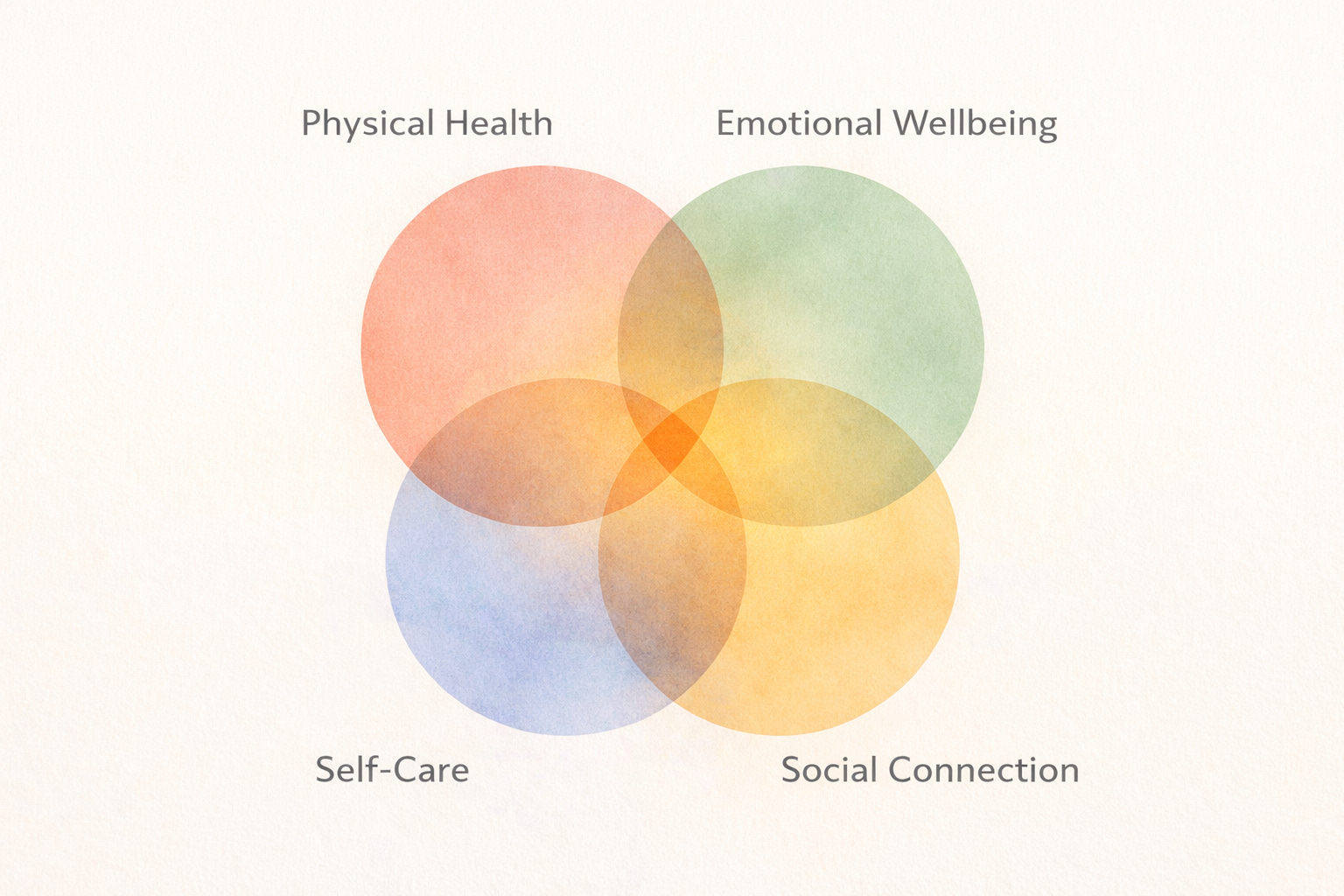
Think of heart health as having four interconnected areas: Physical Health (sleep, stress, eating, movement), Emotional Wellbeing (purpose, identity, structure), Social Connection (relationships and mattering to others), and Self-Care (boundaries, rest, asking for help).
When one area is strong, it helps the others. When you sleep better, you have energy for social activities. When you feel purposeful, you’re motivated to take care of yourself physically. When you have good boundaries, you don’t burn out and have capacity for connection.
But when one area collapses, it drags the others down. If you’re exhausted from never resting, you don’t have energy for connection. If you’re isolated and lonely, you become depressed, which makes physical care harder. If you’re not sleeping, everything else becomes more difficult.
The key is recognizing which area needs attention right now and strengthening it, knowing that improvement there will naturally support the other areas. You can’t maintain everything perfectly all the time, and you don’t need to. You just need to know where to focus.
Three Stories: What Actually Works
These patterns aren’t theoretical. Here’s what they look like in real lives. The following three examples are fictional, but they’re based on patterns I see again and again in the seniors I hear from. One of these stories might sound exactly like your life right now.
Margaret: Starting with Just Sleep
Margaret, seventy-nine, felt overwhelmed by everything her doctor and daughter wanted her to change. She picked one thing from Week 1: she set a consistent bedtime and actually stuck to it.
After two weeks of better sleep, she had slightly more energy. She used that energy to quit one church committee she’d never enjoyed. That freed up Tuesday afternoons.
With those free afternoons and better energy, she started going to the library. She became a regular, chatted with librarians and other regulars, and suddenly had something to look forward to.
By month’s end, she’d changed three things—her bedtime, one obligation, and added one weekly outing. But everything felt different. She had energy, less resentment, and something to look forward to. Her blood pressure even improved.
Margaret’s lesson: Start with one small physical change that gives you more energy, then use that energy to address other areas.
Robert: Finding His Weak Link
Robert, seventy-two, was walking daily, eating well, taking medications—doing “all the right things”—but felt terrible. Exhausted, irritable, high blood pressure despite his efforts.
After Week 3, he realized his problem: he never said no, never rested, helped everyone who asked. He was doing everything for physical health but nothing for self-protection. The chronic stress undermined everything else.
He quit one committee, started saying “let me check my schedule” instead of automatic yes, and scheduled rest time like appointments.
Within a month, his blood pressure came down, irritability decreased, and he had more energy for things he actually wanted to do.
Robert’s lesson: You can’t compensate for weakness in one area by overworking another. If self-care is your weak link, physical efforts won’t be enough.
Linda: Rebuilding After Loss
Linda, sixty-eight, was struggling six months after her husband died. All four areas were collapsing—no structure, no social connections, no energy for self-care, poor physical health. She didn’t know where to start.
She started with structure—created a simple morning routine. Wake at the same time, make coffee, sit and drink it while looking out the window, shower and dress. Just that.
That structure gave her a foundation. From there, she went to the same coffee shop twice a week at the same time. She became a regular, developed weak ties with the barista and other regulars.
With structure and small social connection, she had enough stability to address physical care—consistent sleep times, regular meals, short walks.
By month three, she’d built a life with shape again. Not her old life, but a life.
Linda’s lesson: When everything is struggling, start with structure or one tiny social connection, then build from there.
Recognizing What Needs Attention
Of course, knowing the four areas exist is one thing. Recognizing which one needs your attention right now is another. Here’s what to watch for in your own life.
Your physical health needs attention when sleep becomes irregular—either too much or too little. When pain becomes constant. When you have no energy for basic tasks. When eating happens erratically, or when movement stops entirely. If this sounds like you, go back to Week 1 and pick one thing—usually sleep or stress management—and start there.
Your emotional wellbeing needs attention when days feel meaningless, when you have nothing to look forward to, when you’ve lost sense of who you are. When you’re just going through motions or when grief overwhelms everything. If this is where you’re struggling, go back to Week 2. Create one small structure. Find one small source of purpose. If grief is overwhelming, talk to your doctor about professional support.
Your social connection needs attention when you feel invisible, when you go days without meaningful interaction, when you’re lonely even around people, or when you don’t matter to anyone. Start with weak ties—become a regular somewhere. Show up consistently in one place and let small connections develop naturally.
Your self-care needs attention when you’re exhausted and resentful, when you say yes to everything, when you never rest without guilt, when you won’t ask for help, or when you’re running on empty. Go back to Week 3. Set one boundary, say no to one thing, schedule rest like an appointment, or ask for help with one small thing.
What You’ll Learn Below the Paywall
In the premium section, we show you exactly how to put this into practice in your actual life:
✅ Building Your Personal Approach – Step-by-step process to assess where you are, pick your focus, and create a sustainable plan
✅ When You Fall Off Track – How to restart quickly without guilt when life throws you off course (because it will)
✅ The Long View – What sustainable heart health actually looks like six months, one year, and five years from now
✅ Permission to Start Small – Why good enough is truly enough and how imperfect progress still changes everything