

Your Joy Map Has Changed (And You Haven't Updated It)

Last week we talked about the hedonic treadmill. The psychological mechanism that keeps happiness permanently just out of reach, because no matter what we achieve or acquire or wait for, our brains adapt and the goalposts move. We talked about the difference between happiness, which requires your circumstances to cooperate, and joy, which requires only your attention.
If you missed it, I’d suggest reading it first. It is the foundation for everything we are building this month.
This week the question becomes more personal. Because knowing what joy is and actually being able to find it are two different things. And there is a specific reason most of us struggle to find it, one that has nothing to do with our circumstances or our attitude or how hard we are trying.
We are looking for it in the wrong places. Places where it used to live. Places it quietly left, sometimes years ago, without us noticing.
The Friend I Slowly Lost
There was a friendship that had been part of my life since I was eleven years old. We grew up together, went through everything together, the kind of friend where you don’t need to explain the background to anything because she was already there for all of it.
We didn’t fall out. Nothing happened. We just slowly, gradually, almost imperceptibly drifted. Different cities, different lives, both of us busy. The calls got less frequent. Then occasional. Then mostly birthdays and a message here and there that said we should catch up soon, and we meant it, but we never quite did.
At some point I realized the friendship was gone in any real sense. And I was surprised by how much that sat with me.
What I didn’t fully understand at the time was what I was actually grieving. I thought I was mourning her specifically. And partly I was. But when I was honest with myself, what I missed most was something more specific than that: the particular quality of conversation we had. The kind where you say something half-formed and the other person finishes it in a direction you didn’t expect. Where you leave feeling like you understood something about yourself that you didn’t when you arrived. That feeling of being genuinely known and genuinely interested in someone at the same time.
I told myself for a long time that that kind of friendship just gets harder to find as you get older. That it belonged to a particular era of life when you had the time and proximity for it.
Then I had a conversation with someone I barely knew, a woman I’d met through work, over coffee that was supposed to last forty-five minutes and went on for nearly three hours. And I recognized the feeling immediately. That same quality of aliveness. That same sense of leaving with more than I arrived with.
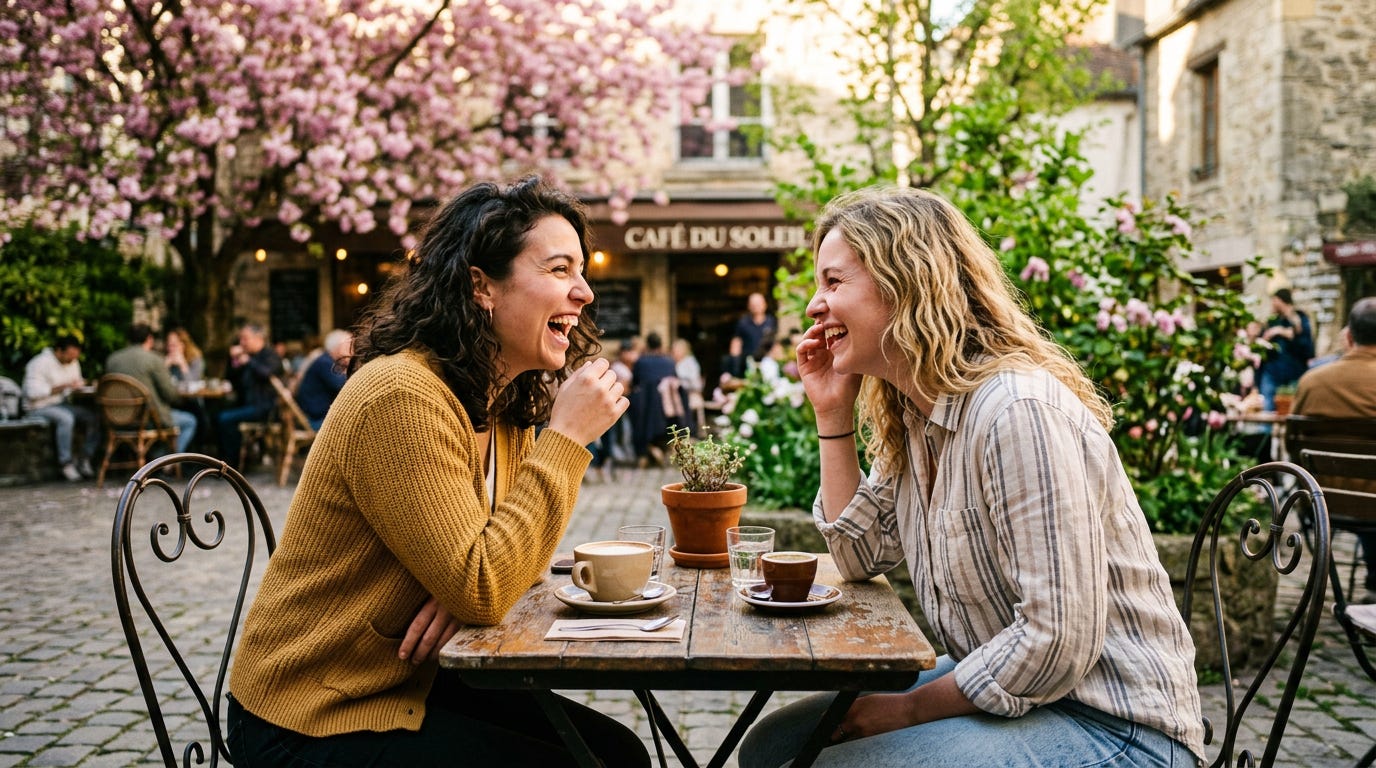
The joy wasn’t locked inside one specific person from my past. It was in a certain kind of conversation that I hadn’t been actively seeking out, because I had decided without realizing it that it was no longer available to me.
It was available. I had just stopped looking for it.
What a Joy Map Is, and Why Yours Needs Updating
Think of your joy map as the collection of specific routes that have reliably taken you to that quality of genuine engagement we talked about last week. A lifelong friendship. Cooking a big Sunday meal for people you love. Your work. Dancing. Gardening. A particular place that always made you feel like yourself.
The map is personal. What lights you up is genuinely not what lights someone else up. And it is not static. It changes throughout life, and the changes accelerate as we get older.
Retirement removes a daily structure that was quietly providing meaning, competence, and social connection all at once. Relationships change and some fade, and with them the specific joy that existed only in their company. Children grow up and no longer need you in the ways that once gave your days their shape. Bodies change and limit physical activities that once felt central to who you were.
Most people do not consciously update their map when these changes happen. They simply notice that the old routes no longer work and draw one of two conclusions: either they are failing somehow, not trying hard enough, not adapting well enough. Or joy itself has become unavailable to them at this stage, a thing that belonged to an earlier version of their life.
Both conclusions are wrong. But they feel true, especially when the old routes have been failing for a long time.
The Grief Underneath the Map
I want to say something about this clearly, because it gets skipped over in most conversations about joy and positivity.
Some of what is on your outdated map deserves to be grieved, not just replaced.
The specific joy of a friendship that knew your whole history. The particular satisfaction of the work you were good at for thirty years. A relationship that shaped who you became. These are real losses. They are not solved by finding substitutes, and anyone who tells you otherwise is not taking the loss seriously enough.
But grief and updating your map are not the same process. You can hold the grief for what is genuinely gone and, separately, ask an honest question: of what is still here, what have I stopped noticing? What routes to joy exist in my actual life right now that I am walking past because I am still facing the wrong direction?
That is the question this week. Not how to replace what you lost. How to find what moved.
Joy Did Not Leave. It Moved.
What the coffee conversation taught me was something I have since found to be almost universally true: the experiences that gave us joy were never really the point. They were vehicles. And when a vehicle is no longer available, the destination usually still is.
The friendship delivered something specific: a quality of conversation, of being known, of genuine mutual curiosity. Those four words, known, curious, honest, alive, are what I was actually after. My childhood friend was the person who gave me that most reliably. But she was not the only possible source of it. I had just stopped looking because I had confused the vehicle with the destination.
Most of your closed gardens work the same way. The experience felt irreplaceable because it delivered several things at once. When you pull it apart and look at what it was actually giving you, you usually find that most of what you genuinely needed is still available. In different forms. Through different doors. At a different scale.
One honest conversation a week is not the same as a forty-year friendship. I want to be clear about that. Some of what is lost is simply lost, and pretending otherwise would be dishonest. But one honest conversation a week is genuinely, meaningfully better than none. And none is what you get when you decide the thing you are looking for no longer exists.
Joy did not leave. It is waiting at a new address. One you have not looked for yet, because you have been too busy facing the old one.
What You’ll Find Below
In the premium section this week:
✅ Your Old Map - A guided exercise to identify your most important historical joy sources and what they were actually giving you beneath the surface
✅ Element Extraction - How to pull the underlying need out of each lost joy source and find new routes to the same feeling
✅ Your New Map - Practical examples organized by the most common joy elements: beauty, connection, mastery, sensation, and meaning
✅ Maybe you... - Scenarios to help you recognize your own outdated map