
The Easiest Exercise Habit You've Never Tried: Movement Snacks
You don't need 30 uninterrupted minutes. You just need two.

Most of us were raised on the same idea about exercise: to count, it has to be a proper session. A walk around the block. A class. Thirty minutes, at least, of sustained effort — or it doesn’t really matter.
That idea is outdated. And for many seniors, it’s quietly been getting in the way.
When the day fills up, when the knees are stiff, when the energy isn’t quite there — the all-or-nothing approach means you end up doing nothing. You tell yourself you’ll get to it later. Later becomes tomorrow. Tomorrow becomes next week.
There’s a better way. And the science behind it is surprisingly compelling.
*I was inspired to write this after reading a Substack article last month, “The Art of the Movement Snack” by Come Back To Your Body. After trying the approach myself and being surprised by how well it worked, I did more research and wanted to share it with you here.

What Is a Movement Snack?
A movement snack is exactly what it sounds like: a small, intentional burst of physical activity woven into your day. Not a workout. Not a session. Just two to five minutes of purposeful movement, repeated several times throughout the day.
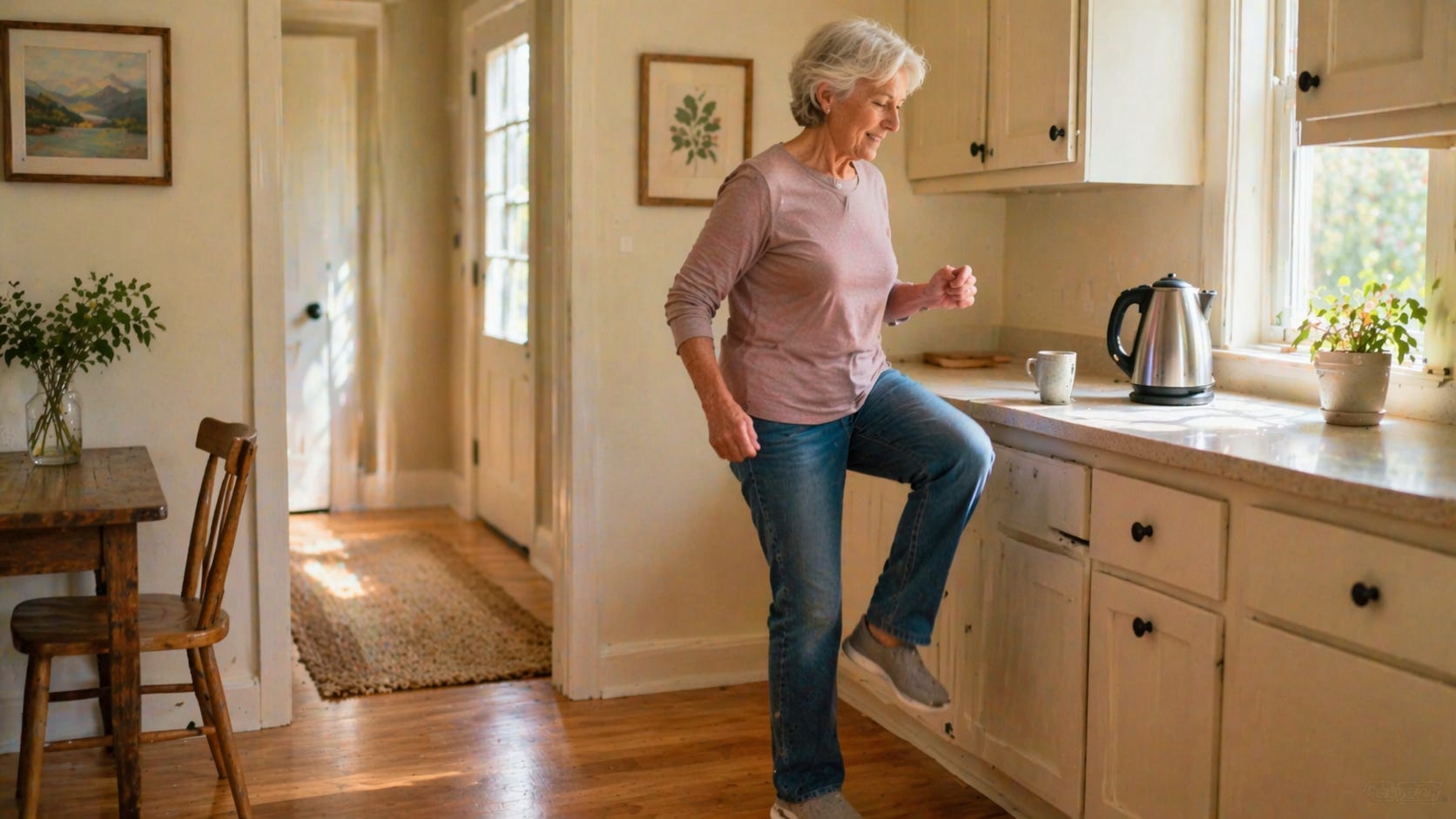
Stand up and march in place while the kettle boils. Do a set of seated leg extensions during the commercial break. Walk to the end of the street and back before lunch. Take the stairs instead of the lift, twice.
That’s it. That’s the whole concept.
Researchers call them “exercise snacks” — brief bouts of movement lasting anywhere from one to five minutes, spaced throughout the day rather than bundled into a single session. And what they’re finding is that these tiny pockets of activity add up to something real.
The Problem With Sitting Still
Before we get to the good part, it helps to understand what we’re working against.
Most older adults spend the majority of their waking hours seated. Watching television, reading, eating meals, using a computer, riding in a car. It adds up quickly — often to eight, ten, or even twelve hours of sitting per day.
Here’s what researchers have found: prolonged sitting is dangerous even if you exercise regularly. A person who goes for a 30-minute walk every morning but then sits for the rest of the day is still at meaningfully elevated risk for heart disease, type 2 diabetes, and cognitive decline. The walk doesn’t fully cancel out the sitting.
This surprised a lot of scientists when the evidence first emerged. We assumed that hitting a daily exercise target was enough. It turns out, the body also needs to be interrupted. It needs small reminders, throughout the day, that it is alive and in use.
The negative effects of prolonged sitting — stiffening of blood vessels, rising blood sugar, slowing circulation — can begin to accumulate within an hour of sitting down. But research shows that as little as two minutes of large-muscle movement is enough to interrupt that process and reset the clock.
Two minutes.
What the Research Actually Shows
The evidence on exercise snacks has grown significantly over the past few years, and the results are striking.
A 2022 study published in Nature Medicine found that people who engaged in just three short bouts of vigorous physical activity per day — each lasting one to two minutes — had a 48 to 49 percent lower risk of cardiovascular death compared to those who did none. Not 10 percent lower. Nearly half.
Separate research has linked regular exercise snacks to better cognitive function in older adults, with participants who took short two-to-five-minute movement breaks showing measurably higher mental function than those who stayed seated. Given what we know about the connection between physical activity and brain health, this isn’t surprising — but the size of the effect from such small efforts is.
A systematic review published in 2025 confirmed that brief exercise snacks consistently improve glucose control, blood pressure, cardiovascular fitness, and mood across adult populations — including older adults. They also found that these short bouts are well tolerated, meaning people actually keep doing them. They don’t burn out or drop off the way they often do with longer routines.
That last part matters. The best exercise habit is the one you actually sustain.
How Movement Snacks Fit Into What You’re Already Doing
If you’ve read our articles on walking and chair exercises, you already have everything you need. Movement snacks aren’t a separate program. They’re a new way of using the same movements — scattered across your day instead of grouped into one session.
A short walk is still a walk. Seated marches, leg extensions, ankle circles — all of the chair exercises we’ve covered work perfectly as two-to-three-minute movement snacks. The difference is when and how you think about doing them.
Instead of carving out a dedicated exercise window (and then feeling like you’ve failed if it doesn’t happen), you start looking at your day for natural gaps. The moments between things. The transitions. The pauses.
Those gaps are already there. You just haven’t been using them.
What a Movement Snack Day Actually Looks Like
Here’s a simple example of how this might look in practice. None of these moments require changing clothes, leaving the house, or interrupting anything important.
Morning: You wake up and, before reaching for your phone, spend two minutes doing seated ankle circles and leg extensions at the edge of the bed. Your joints get a gentle warm-up. Your circulation kicks in. The day begins with movement instead of stillness.
Mid-morning: The kettle goes on for your second cup of tea. Instead of standing and waiting, you march in place — lifting your knees, swinging your arms — for the two minutes it takes to boil. You’ve just done a cardiovascular movement snack without thinking of it as exercise at all.
Before lunch: A short walk — even just to the end of the street and back. Five minutes. Fresh air, a change of scenery, and the cardiovascular benefits we covered in our walking article. If the weather is bad, walk laps of your living room or hallway instead.
Afternoon: You’ve been sitting for an hour watching television or reading. Stand up during a break and do ten sit-to-stands — the most functional exercise in the chair exercise repertoire, and one of the best things you can do for your leg strength and independence. Sit back down. That was ninety seconds.
Before dinner: Another short walk, or a two-minute bout of marching and shoulder raises. Something that gets your blood moving before the evening settles in.
After dinner: A gentle ten-minute stroll. Research consistently shows that walking after meals helps regulate blood sugar — particularly relevant for seniors managing or at risk of type 2 diabetes. This one earns its place on its own merits.
Six movement moments. None longer than ten minutes. Total active time: roughly twenty to thirty minutes — but spread across the whole day, making each one effortless to fit in.
Your Questions Answered
“Does this really work as well as a proper exercise session?”
It depends what you’re comparing. For cardiovascular health, blood sugar regulation, and cognitive function, the research says yes — short, frequent bouts can be just as effective as a single longer session, and sometimes more so, because they keep the body’s systems active throughout the day rather than just for one concentrated period. For building muscle strength, longer and more structured resistance training still has advantages — which is why a routine like the chair exercise program remains valuable. Movement snacks complement that work; they don’t replace it.
“What if I already go for a daily walk? Do I still need movement snacks?”
Your daily walk is excellent — we’d never suggest dropping it. But if you walk in the morning and then sit for most of the remaining twelve hours, adding a few short movement breaks in the afternoon and evening will meaningfully extend the benefits of that walk. Think of it as protecting the investment you’re already making.
“I have joint pain. Are these movements safe?”
Gentle, controlled movements of the kind we’ve covered in our chair exercise guide are generally well-suited to people with arthritis and joint pain. Movement helps lubricate the joints and improve circulation — most people find that regular gentle activity reduces their stiffness over time rather than worsening it. That said, always check with your doctor if you have a specific condition or are recovering from surgery.
“How do I remember to do them?”
Habit pairing is the most reliable method. Attach a movement snack to something you already do every day — making tea, commercial breaks, washing your hands, waiting for something to heat in the microwave. Once the trigger is established, the movement follows naturally. A sticky note on the kettle or the television remote is surprisingly effective.
Start Small, Stay Consistent
The beauty of movement snacks is that there is almost no barrier to starting. You don’t need a free hour. You don’t need good weather. You don’t need to change your clothes or drive somewhere.
You need two minutes and the decision to use them.
That’s a decision you can make right now. Stand up, march in place for two minutes, and sit back down. You’ve just taken your first movement snack. You’ve interrupted your sitting, activated your muscles, and given your cardiovascular system a small but genuine boost.
It doesn’t feel like much. But done consistently, several times a day, every day — it adds up to something that research increasingly shows is one of the most powerful things you can do for your long-term health.
Small, frequent, sustainable. That’s the formula. And it starts with the next time you notice yourself sitting still.
Enjoyed this article? Share it with someone who could use a nudge to get moving.
I love movement snacks!!! Great article!!