

Being Mortal: When Fighting Isn't the Brave Choice Anymore

Hi, it’s Diana from We Get Better with Age, and I’m continuing my series on books I’ve read and genuinely enjoyed. I’ll be honest with you from the start: this one is not an easy read. But it’s a book I recommend with my whole heart — because it put words to something most of us spend our lives carefully not looking at, and I haven’t stopped thinking about it since.
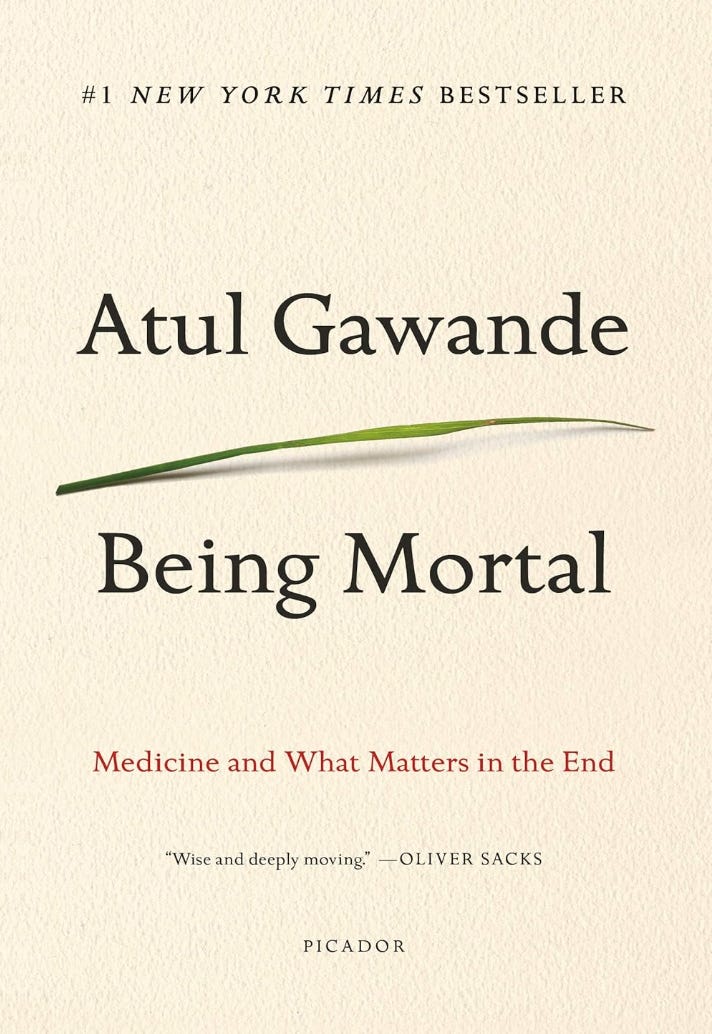
The book is Being Mortal, by the surgeon Atul Gawande, and it opens with a woman named Sara Monopoli. She was thirty-four, pregnant with her first child, when she was diagnosed with stage IV lung cancer — and she had never smoked. Over the months that followed, she went through four rounds of chemotherapy. None of it shrank her tumors. What it did instead was weaken her, suppress her immune system, and eventually leave her vulnerable to the pneumonia that took her life in a hospital, still chasing a treatment that almost no one around her believed would work.
Gawande doesn’t tell her story to assign blame. He tells it because almost everyone in it — the doctors, the family, Sara herself — was doing exactly what we’re all trained to do. Keep going. Try the next thing. Don’t give up. And he asks a question that takes the whole book to answer: what if “don’t give up” is sometimes the cruelest advice we give the people we love?
That’s what Being Mortal is really about. Not death, exactly. The question of when fighting stops being brave — and what it means to face the end with acceptance and dignity instead.
The Story Medicine Doesn’t Know How to Tell
Here’s the idea at the center of the book, and it reframed something I had never thought to question: modern medicine is built to fight, and it has almost no idea what to do when fighting is no longer the point.
Gawande is honest about his own training. Doctors, he writes, are taught to see death as the enemy — as a failure to be defeated, never a passage to be accompanied. The whole system is organized around that reflex. There is always another scan, another drug, another procedure, another round. And for most of medicine’s history, that relentlessness has been a gift; it’s the reason so many of us are here at all.
But the reflex doesn’t know when to stop. As the body reaches its real limits — in serious illness, in great age — the fight changes character. It stops buying good time and starts buying suffering: more days, yes, but days spent in hospitals, hooked to machines, recovering from one intervention just in time for the next. We keep treating mortality as a problem to be solved, right up to the very last moment, because the alternative feels like surrender.
And so the conversation that matters most almost never happens. Nobody wants to be the one to say this isn’t working anymore. The doctor doesn’t want to take away hope. The family doesn’t want to feel like they’re giving up. The patient doesn’t want to disappoint the people fighting so hard for them. So everyone keeps going, together, past the point where any of it serves the person at the center. The avoidance feels like love. Often, it’s just fear wearing love’s clothes.
You are allowed to question the fight. That’s not the same as wanting to lose it.
What “Doing Everything” Actually Costs
We have a phrase we reach for in these moments: do everything. Do everything you can. It sounds like the most loving thing in the world, and sometimes it is.
But Gawande makes you sit with what “everything” can mean. It can mean a person spends their final months as a patient instead of a parent, a partner, a self — their remaining time consumed by treatments that were never likely to work, recovering in waiting rooms instead of living in their own kitchen. It can mean dying among strangers and monitors, rather than at home among the people who love you. “Doing everything” is not free. Its currency is the very thing that’s running out: time, and the quality of it.
And here’s why I think this matters long before any hospital room: it’s the same logic that shapes the smaller decisions of getting older, too. The instinct to choose more — more procedures, more precautions, more intervention — over what actually makes a day feel like yours. We rehearse “do everything” in a hundred quiet ways as we age, and by the time the big version arrives, it’s the only script we know. Reading this book early is a way of writing yourself a different one.
It makes sense that we default to it. Stopping feels like consenting to the thing we’re most afraid of. Naming that fear honestly is the only way past it — and this is where the book refuses easy comfort. It doesn’t pretend death is a gift, or that decline is secretly beautiful. There’s none of that forced brightness here. It looks straight at the hardest fact of being human — that our bodies are finite, and we don’t get to negotiate that — and instead of flinching, it asks a better question. Not how do we win, but what is this fight actually for, and is it still serving the person we’re fighting for?
That question is not giving up. It’s the opposite. It’s refusing to let the machinery of treatment make the most important decision of someone’s life by default.
What I Watched Happen
I want to tell you something personal, because this book pressed on a place I already knew.
My grandmother died a few months short of her ninetieth birthday. But the truth is that the woman I knew had been gone for years before that. In her last years she was bedridden, in diapers, fed by someone else’s hands, and at some point she stopped responding to anything at all — a name, a voice, a touch. There was never a clear diagnosis. The doctors said it was a form of dementia and left it there. What I remember is plainer than any word they offered: there was nothing left of my grandmother. Just a frail body that stubbornly went on living, long after the person inside it had slipped away. And that — I have to say it honestly — was not a life. It was the absence of one, kept breathing.
My mother cared for her through all of it, to the very last moment, with a tenderness I’m not sure I could have summoned. I don’t tell you this to question a single thing she did. I tell you because of what it taught me, slowly and without my permission: that staying alive and being alive are not the same thing. That a heart can keep going long after everything that made a person them has quietly left the room. And that the goal can’t simply be more time, when “more time” has stopped meaning anything to the person living it.
That’s the experience Gawande put words to for me. I had felt it for years without knowing how to say it. He says it.
The Part That Surprised Me Most
Here’s where the book turns, and where it earned my trust completely — because it doesn’t just argue from the heart. It argues from the evidence.
You’d assume that choosing comfort over aggressive treatment means trading length of life for quality. Less fighting, less time. Gawande shows that the truth is stranger and gentler than that. In a study of patients with terminal lung cancer published in the New England Journal of Medicine, the people who received early palliative care — care focused on comfort, on quality of life, on exactly the honest conversations most of us avoid — didn’t only suffer less. They lived longer than the patients given aggressive treatment alone. Up to twenty-five percent longer, in some findings.
Let that land for a moment. The people who stopped pouring everything into fighting, and started attending to how they actually wanted to live, got more time and better time. Gawande calls it the almost Zen paradox at the heart of the book: you live longer only when you stop trying to live longer.
This is why he comes to see hospice not as the place you go to give up, but as one of the most humane things medicine offers — a model of care built around making a person’s remaining weeks rich and dignified rather than merely prolonged. The goal quietly shifts. Not the most days possible. The best life possible, all the way to the end. Those turn out to be two different projects, and we spend enormous effort confusing them.
The Conversation That Changes the Ending
If there’s one practical thing I took from Being Mortal, it’s this: the ending is shaped, more than by any treatment, by a conversation most families never have.
Gawande learned this in the most personal way. His own father, also a surgeon, developed a tumor in his spinal cord. The instinct — his, the family’s, the profession’s — would have been to operate immediately, to act. Instead, his surgeon, Edward Benzel, did something rarer. He asked what mattered most. For Gawande’s father, the answer was clear: he wanted to keep operating, to keep being himself, for as long as he could. So they waited. That choice gave him two more good years doing the work he loved — years an immediate, aggressive intervention might have cost him.
And when the disease finally advanced, the same honesty guided the end. Because his family knew what he valued, they could let him choose hospice, and he died at home, surrounded by the people he loved, rather than in a fight he no longer wanted. The conversation didn’t make the loss smaller. It made the ending his own.
That conversation isn’t one grim sit-down. It’s a handful of honest questions, asked early, while there’s still room to answer them calmly. Gawande comes back to a few again and again: What are your biggest fears and hopes if time grows short? What outcomes are unacceptable to you? What are you willing to go through — and not go through — for the chance of more time? And what does a good day actually look like for you?
These aren’t questions about dying. They’re questions about what you’re living for. And the answers change everything that comes after, because suddenly the people around you have something to steer by, instead of guessing in a hospital corridor at the worst possible moment.
I’ve watched, in my own family, how much weight that guessing carries when no one has spoken plainly. The greatest gift my parents could give us, I’ve come to believe, isn’t to fight forever. It’s to tell us, while it’s easy to talk about, what a good ending would mean to them — so that one day we’re carrying out their wishes, not our panic.
What Dignity at the End Really Means
I don’t recommend Being Mortal because it’s comforting. I recommend it because it’s honest, and there’s a particular relief in honesty that comfort can’t reach.
The dignity Gawande writes about isn’t grand or dramatic. It’s the simple, radical idea that a person remains the author of their own life all the way to its last chapter — that even at the end, what they want should matter more than what the machinery defaults to. Accepting mortality, in his telling, isn’t defeat or passivity. It’s a kind of clear-eyed courage: the willingness to look at the limits of a life honestly, and to spend what remains on what actually matters, rather than on a fight that costs more than it can ever return.
That question doesn’t belong only to the very ill, or only to the very old. It belongs now. Every one of us will face some version of it — for a parent, for a partner, eventually for ourselves. And the people who face it best are almost always the ones who let themselves think about it before it arrived, while it was still a conversation and not yet a crisis.
So I’ll leave you with the question the book left with me, not to solve in an afternoon but to sit with: If your time were shorter than you’d like, what would make the days that remained good ones — and does anyone who loves you actually know the answer?
You don’t have to have it figured out. You just have to be willing to ask. That’s the whole of it. The asking is the kindness — to the people who love you, and to the person you’re still becoming, right up to the very end.
So yes — read it. Not because it’s easy, because it isn’t, and I won’t pretend otherwise. Read it because it’s one of the rare books that takes the thing we’re most afraid to look at and makes it a little less frightening to face. I recommend it with my whole heart.
"The goal can't simply be more time, when 'more time' has stopped meaning anything to the person living it" is the line that stopped me. I'm 79 and have thought about this more than I let on. Your grandmother's story made it concrete in a way the clinical parts couldn't.
What you wrote about avoidance feeling like love but really being fear wearing love's clothes landed hard too. That's a phrase worth carrying around.
I write about pickleball, not mortality, but the question you left readers with applies everywhere: does anyone who loves you actually know the answer? Worth asking at any age.
Thank you for this book recommendation! 👍👏 I’ll definitely purchase this!