

Aging in Place or Senior Living: How To Actually Decide

You already know that every month we go deeper on a theme in the Sunday articles. June is about independence in everyday life — making things easier, getting more organized, accepting support without losing control, rebuilding confidence in your own capacity. There’s a lot to say about all of that, and we’ll get into it.
Before we do, there’s another conversation that needs to happen first.
This conversation usually arrives after something. A fall. A diagnosis. A drive home from the doctor where nobody says much, and the silence in the car does all the work. Or sometimes it comes without a trigger at all — just a Sunday afternoon when the house feels too quiet, or a morning when something ordinary becomes surprisingly hard, and you sit there with the question hovering just above your head, the one you’ve been circling for months without quite landing on it.
Have you thought about what you want to do?
Someone you love will eventually ask this. Maybe they already have. And by “what you want to do,” they mean the practical thing: stay home, or move somewhere with more support?
What the question is really asking, underneath the logistics and the worry, is something closer to: who do you want to be for the next chapter of your life? What kind of days do you want to build? Where does the version of you that still has things to do, things to become, actually get to live?
That is the question worth sitting with. And it deserves something more spacious than a checklist.
This decision carries more emotional weight than people admit
One of the things that makes this particular question so hard is that it arrives already loaded with meaning — meaning that often has very little to do with your actual situation and a great deal to do with the stories our culture tells about aging.
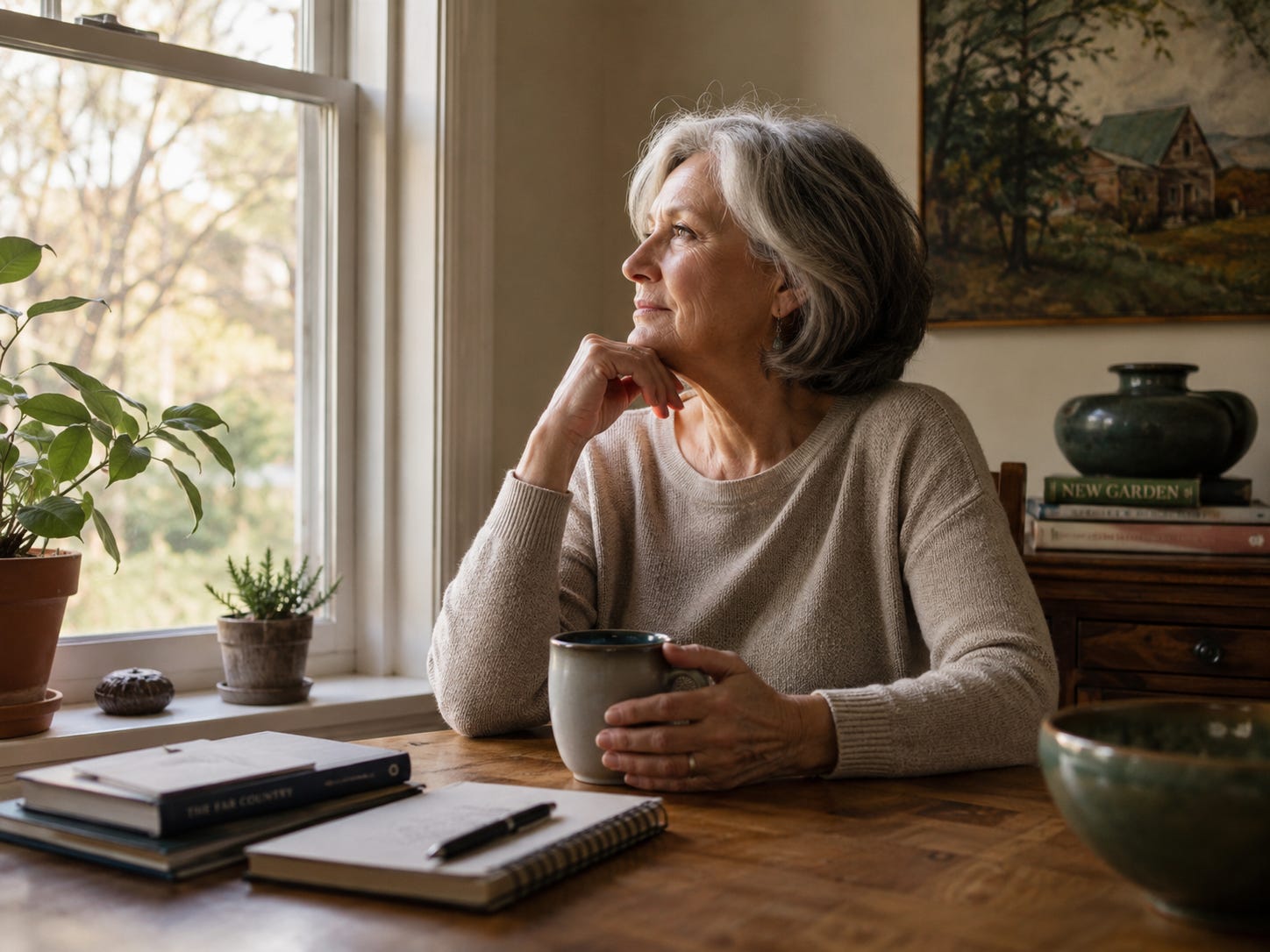
Staying in your home gets coded as independence, dignity, winning. Moving somewhere with support gets coded as decline, surrender, the beginning of the end. These are the invisible labels that travel with the decision, and they shape how people feel about their options long before they’ve looked at a single floor plan or had a single honest conversation with their doctor.
My aunt lived alone in her apartment for seven years after my uncle died — an apartment she’d decorated herself, that held thirty years of their life together, that she knew with the kind of ease that comes from deep familiarity. She stayed because it was her home, and that was a real and legitimate reason. She also stayed, I think, because moving felt like admitting something she wasn’t ready to admit. The two reasons got tangled together in ways she never quite separated.
She moved eventually, into a community about twenty minutes away with a strong program and people she came to genuinely love. She tells me now that she wishes she’d moved two years earlier — before the isolation set in, before the winters felt so long, before her world had quietly contracted to the size of her apartment.
That’s one story. I know people who’ve made the opposite choice and found it was exactly right. The point is that she spent two years living inside the wrong question — “can I stay?” rather than “what do I actually need, and where can I get it?”
The guilt runs in both directions, and neither version is telling you the truth
Here is something worth naming before you go any further: the guilt that comes with this decision is real, and it runs in both directions.
If you want to stay in your home, you may find yourself thinking about the people who love you — the ones who will worry, who will drive across town, who will lie awake at night imagining scenarios. You may find yourself asking whether staying is a kind of selfishness, whether the life you want to hold onto is costing someone else something you haven’t fully calculated.
If you’ve started imagining a different kind of place — somewhere with meals you didn’t have to cook, with people nearby without having to arrange it, with staff who are trained for exactly this moment in life — you may find yourself feeling like you’ve given something up before you even started the conversation. Like the wanting itself is a confession.
Both of those feelings make complete sense. And both of them deserve to be set down before you try to make a clear-eyed decision, because they will cloud everything.
The desire to stay in your home is deeply reasonable. Familiar environments genuinely support cognitive function and emotional wellbeing — decades of research confirm what most people already feel intuitively. Your home holds your routines, your objects, your sense of mastery over your own life. These are serious, legitimate things.
The desire for community, structure, and support is equally reasonable. Isolation is among the strongest predictors of cognitive decline and shortened life, and that finding has replicated across study after study. Connection, stimulation, and a structured rhythm of days can extend both the length and quality of life. The evidence here is just as solid.
You are allowed to want what you want. The wanting itself is information, and it’s worth listening to before you start weighing the practical factors.
Three questions worth sitting with — in this order
The standard checklists exist, and they’re useful eventually. Can you safely manage the stairs? What would home modification cost? What does long-term care insurance cover? These are real questions and they deserve real answers.
Start somewhere else.
What does a good day look like, and where does it actually happen?
A regular Tuesday, specifically. The best day of your life isn’t useful data here — it’s the ordinary day that tells you something true.
You wake up. You make coffee. What comes next? Who’s there, or not there by choice? What do you move toward in the morning hours? What makes the afternoon feel like it belongs to you? What does the evening ask of you?
Now hold that image and ask: does my current home support that Tuesday? Could a different setting support it better, or more fully, or with less effort on your part?
Some people’s good days require a particular garden, a kitchen they know by feel, the specific light that comes through a window they’ve been waking up to for thirty years. Those days carry a geography that matters, and moving would mean rebuilding something that took decades to build. Some people’s good days require other people in proximity — the texture of community, the knowledge that someone is nearby, the low-level hum of shared life that a solo apartment simply cannot provide. Those days might transfer to a different setting far better than the person imagines.
Neither answer is wrong. Both answers are real. The work is in knowing which one is yours, honestly, before the pressure of a situation forces you to decide.
What is the fear underneath the stated fear?
Most people say some version of the same things: afraid of losing independence, afraid of being a burden, afraid of being “put somewhere.” These are all real fears. They’re also sometimes covering for something more specific, and it’s worth going one layer deeper.
When you say you’re afraid of losing independence — what does independence actually mean to you, concretely? Is it the physical capacity to drive, to manage your own medications, to come and go without anyone’s awareness? Is it the ability to make decisions about your own life without needing to justify them? Is it something subtler — the feeling of being competent in your own environment, of knowing where things are and how things work?
When you say you’re afraid of moving somewhere — what is the specific fear? That you’ll disappear? That the person you’ve spent a lifetime becoming will become invisible, absorbed into a category? That you’ll lose the particular story of who you are?
These fears are worth naming fully before you try to answer the practical question, because they’ll shape how you evaluate every option you look at. A fear of losing decision-making autonomy should probably make you look very carefully at the governance structure of any community you consider — how much say residents have, how much your preferences actually matter day to day. A fear of invisibility might mean that the quality of the programming and the strength of the community matters far more than the square footage of the apartment.
Your fear is a map. It’s worth reading it.
What has already shifted, and what does the next shift look like?
My aunt stayed in her apartment for reasons that made sense at the time she first made the decision. What she underestimated — what most people underestimate — is how gradual the changes were in the first years, and how that gradualness made them easier to absorb than to see clearly.
The question to sit with is this one: what has already become harder, and what would a second change — a health event, an accident, a year of the kind of isolation that winter brings — mean for your options?
This is a question designed to create space for honesty while you still have the luxury of time. Decisions made from a position of stability are different in quality from decisions made in the middle of a crisis, and the people who are clearest about this tend to be the ones who looked at the trajectory while they had the option of looking slowly.
What the research says about thriving — in either setting
The research on this topic is more nuanced than the cultural conversation suggests, and it’s worth knowing what it actually shows rather than relying on the simplified version.
People who age in place and report high wellbeing over time tend to share a specific cluster of factors: they have genuine, chosen social connection — relationships they’ve cultivated actively, and kept cultivating; they remain physically engaged in whatever form their bodies support; and they feel a sense of competence and mastery in managing their daily lives. When those factors are present, aging in place works remarkably well. When they erode — when connection thins, when physical engagement becomes harder without support, when managing the environment starts to feel like a burden rather than a source of pride — wellbeing erodes with them.
People who move to senior living communities and report high wellbeing share a different but equally consistent cluster: they chose to move, rather than being moved in crisis; they moved earlier in their trajectory rather than later; and they found genuine community in the new environment rather than just a collection of services. The communities that produce the best outcomes tend to be the ones with strong programming, resident governance, and a culture that treats residents as full people with full lives rather than as people in need of management.
The research is making an argument for intention. For choosing rather than defaulting. For staying connected either way. The people who struggle most, across both settings, tend to be the ones who arrived at their situation without having chosen it — who stayed out of inertia, or who moved because a crisis made the decision for them before they’d had the chance to decide for themselves.
Enjoying this? Plus members get exclusive Sunday deep-dives, a printable 60-page Fun Pack every month, and full library access. $10/month or $97/year.
The spectrum between the two poles
The framing that gets used most often — aging in place versus senior living — implies a binary that does not actually exist.
Between the home exactly as it is and a full-care facility, there is a wide and varied landscape. Home modifications can make an existing space significantly safer and more functional without changing its essential character. Home health aides can provide the kind of support that makes independence genuinely sustainable. Independent living communities function less like care facilities and more like neighborhoods with built-in infrastructure — people choose them for the community and the freedom from maintenance, far more than for medical support. Assisted living communities range enormously in culture, programming, and resident autonomy. Naturally occurring retirement communities, neighborhoods where a critical mass of older residents have simply stayed, often develop their own informal support systems organically over time.
The decision is larger than “my house or somewhere else.” It is a question of what kind of life you are building, what that life actually requires, and which options are genuinely available to you — financially, geographically, physically, and in terms of what you’re ready for.
That question takes more than an afternoon to answer well. And it is worth the time.
A note on money
I know some of these options carry a price tag that puts them out of reach for a lot of people, and I want to name that directly rather than pretend it isn’t real. The financial side of this decision is its own conversation — a serious one, with its own research, its own planning frameworks, its own set of questions that deserve careful attention. We’ll get into it.
For this article, I’m deliberately setting it aside. The reason is this: most people skip straight to the financial question as a way of avoiding the harder one. “I could never afford it anyway” becomes a reason to stop thinking, when the thinking is actually the most important part. If you’ve settled the question of what you actually want — what kind of life you’re building and where it can happen — the financial piece has something real to work with. If you haven’t settled it, the numbers are just a distraction.
So for now — assume money is not the deciding factor. Answer the real questions first.
Let that land for a moment.
You have probably been thinking about this mostly in terms of what is manageable, what your family wants, what the finances look like. All of that matters and will need to be worked through carefully.
Before you optimize for any of it — get clear on what you want. The actual thing, underneath the guilt and the cultural noise and the pressure to seem like you’re handling this well.
You are allowed to want to stay in your home deeply and completely, even when people who love you are worried. You are allowed to want a different kind of life — more connection, more ease, a different rhythm — even when the leaving feels like grief. You are allowed to look at your options clearly and change your mind as you learn more. You are allowed to take the time this question deserves.
You built a life. You know how to make decisions.
This one is yours.
Has this conversation come up for you — or for someone you love? Reply and tell me where you are with it. I actually read every one.
This resonates with me. Wherever we choose to age, the goal should be the same: maintaining independence without losing connection.
My husband and I are in our mid-70s. We are in the process of creating an irrevocable trust with our daughter. We moved from Scottsdale, Arizona to Louisville, Kentucky to be closer to her. She is our only child. We are now a mile apart. We bought a condo garden home in a 48 home neighborhood. We're 95% of the people are retired. I have made close friends with a group here in this development. We go out to dinner regularly and play bunco, dominoes and cards together. I found a church that is supportive and people in the community go there as well. It is ideal for now. I continue to declutter and organize so my daughter will not have to deal with this and not have to go through probate as I did with my mother and brother.