

The Small Changes at Home That Make Everyday Life Feel Easier Again

Now that June is underway, I want to begin the new theme we will be exploring together this month.
If April was about joy, and May was about new beginnings, then this month is about something quieter, more practical, and, in its own way, just as important.
This month, we are turning our attention to independence.Not the harsh, outdated version of independence that says you should be able to do everything by yourself, without support, without adjustment, and without ever changing the way you live.
I mean something wiser than that.
I mean the kind of independence that asks whether your daily life still works for you. Whether your home supports your energy, or quietly drains it. Whether your routines help you move through the day with steadiness and confidence, or whether they ask more of you than they need to.
Over the next few Sundays, we are going to stay with the practical side of living well. We are going to look at the ordinary points of friction that slowly wear people down. The quiet systems that make life feel more manageable. The complicated relationship many people have with help. The habits that help a person feel capable again.
Because for many people, independence is not lost in one dramatic moment.
It is worn away slowly, by ordinary life becoming harder than it needs to be. By the hallway that is too dim. By the chair that has become harder to rise from. By the papers that never seem to have a proper place to land. By the repeated feeling that even simple tasks now ask for too much effort, too much balance, too much remembering, or too much patience.
So today, we begin at the beginning.
We begin at home.
The afternoon I realized my parents were more worn down than they needed to be
A few years ago, I was at my parents’ house on one of those completely ordinary afternoons when nothing dramatic is happening, and that is exactly why you notice what matters.
My mother was in the kitchen making tea. My father was trying to find a bill he was certain he had put somewhere sensible. The radio was on softly in the next room. Light was coming through the window in that gentle late afternoon way that makes everything look calm from the outside.
And yet the whole house felt full of tiny interruptions.
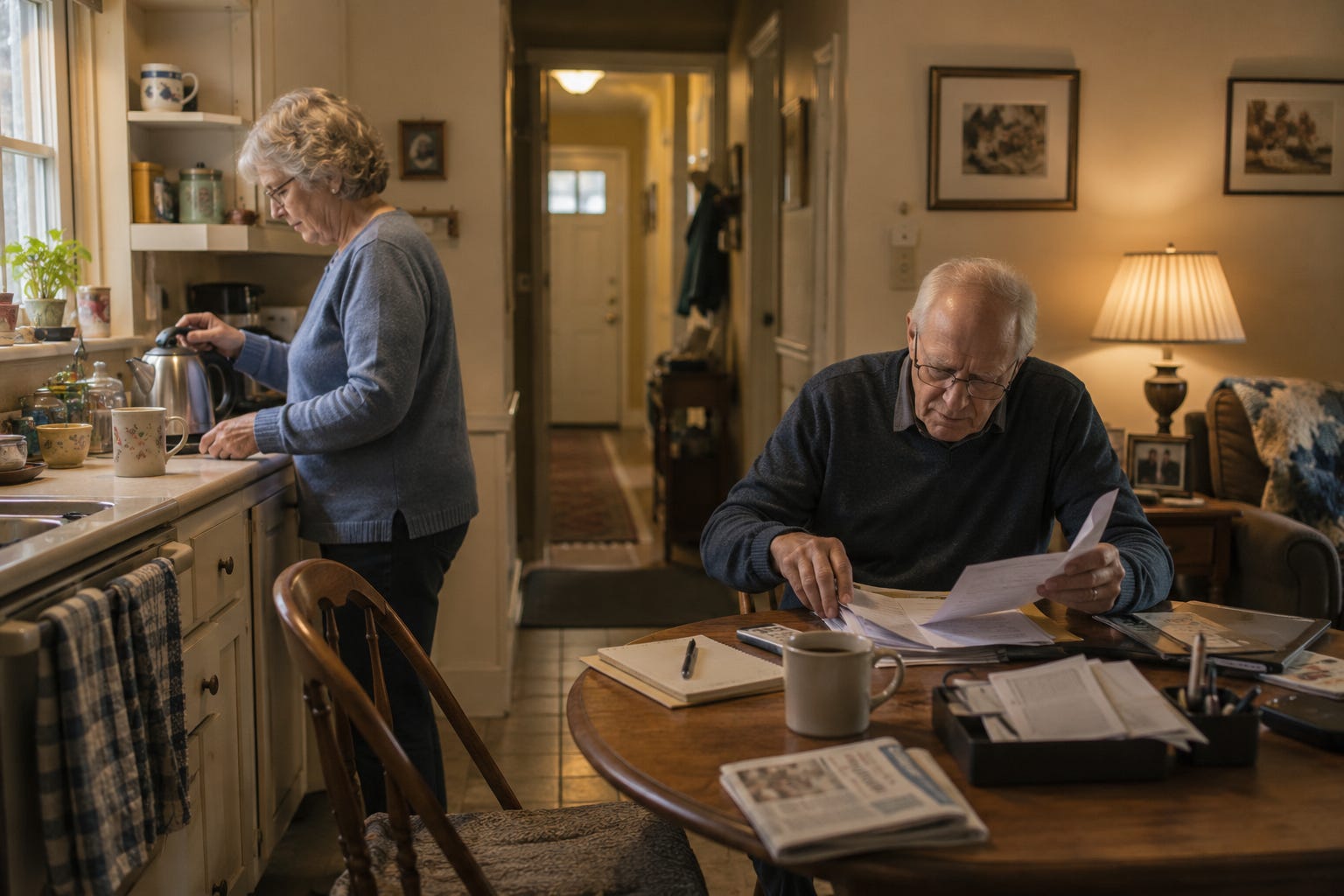
My mother crossed the kitchen more times than she should have had to, because the mugs were in one place, the tea bags were in another, and the kettle lived where it had always lived, not where it made the most sense now. She bent to reach something she used often, then stood up slowly, not because anything was badly wrong, but because that movement clearly asked more of her than it used to. My father moved from the kitchen counter to the table to the chair near the door, looking for a paper that had migrated through the house, as papers do when there is no real system holding them in place.
Neither of them complained.
Neither of them would have said the day was difficult.
But by late afternoon, both of them looked tired in a way that felt familiar and unnecessary. The low, accumulating weariness that settles in when ordinary life keeps asking for small extra efforts all day long. A little extra reaching. A little extra bending. A little extra searching. A little extra caution. A little extra decision-making.
I remember thinking very clearly, this is not only about age.
This is about friction.
It is about a home, and a set of routines, that no longer fit the people living inside them as well as they once did.
Why ordinary life starts feeling more tiring than it should
Most of us are very good at noticing big problems.
We notice a frightening diagnosis. We notice a major financial change. We notice a serious fall, a loss, a move, or a limitation that can no longer be ignored.
What we often do not notice, at least not right away, are the smaller everyday mismatches between a person and the way life is arranged.
The lamp that is too dim where it matters most. The chair that is slightly harder to rise from. The plates stored on the shelf that asks for more reaching than the body wants to give. The shoes that are never where they need to be. The pile of papers that turns one simple task into a tiring little hunt. The path through a room that is just crowded enough to make the body move more cautiously.
None of these things sounds dramatic on its own.
That is exactly why they matter.
They do not announce themselves as problems. They simply ask for a little more, over and over again, until a person ends the day more worn down than they realize.
This matters not only for comfort, but for safety too. The Centers for Disease Control and Prevention says that more than one in four adults age 65 and older falls each year, and both the CDC and the National Institute on Aging point to simple home changes, such as improving lighting, removing tripping hazards, and adding grab bars, as meaningful ways to reduce risk and support independence at home (source). The National Institute on Aging also recommends room-by-room fall prevention steps at home, including clearing pathways, improving lighting, and keeping frequently used items easy to reach (source).
There is also the mental side of this that people often underestimate. A cluttered or poorly functioning home does not just create inconvenience. It can create stress. The American Psychological Association notes that cluttered environments can contribute to stress and anxiety and make it harder to focus (source).
So when someone says, “I do not know why everything feels more tiring lately,” part of the answer may be physical, part of it may be emotional, and part of it may be very practical.
Their daily life may simply be asking too much of them in too many small ways.
The quiet way confidence gets worn down
One of the things I have seen most clearly with my parents, and with many older adults around them, is that confidence often fades quietly.
Through repetition.
You avoid one cupboard because it is awkward to reach into. You stop using one part of the house as much because it feels less easy than it used to. You begin postponing certain tasks because they involve too many steps, too much searching, or too much carrying. You make the easier meal, not because you want to, but because the kitchen is asking more of you than your energy is willing to give. You tell yourself you will deal with the papers tomorrow because right now it all feels just slightly too annoying.
After a while, the conclusion begins to feel personal:
I am not handling things as well as I used to.
I do not have the energy I should.
I cannot seem to stay on top of anything anymore.
But often the truth is more generous than that.
It may not be that you are less capable than you think.
It may be that life at home has become inefficient, cluttered, physically demanding, or mentally draining in ways that make reasonable tasks feel harder than they need to feel.
That distinction matters, because if the problem lives entirely inside the person, then the only answer is to push harder.
But if part of the problem lives in the setup, then the answer is different.
Then the answer is to make life easier.
The National Institute on Aging makes this point in its guidance on aging in place, explaining that living at home longer often requires planning, support, and changes that make the home safer and easier to manage.
What easier actually looks like
Easier is not giving up. Easier is intelligence.
Easier is putting the kettle where it is actually used. Easier is moving the everyday dishes to the shelf that makes sense now, not the shelf that made sense ten years ago. Easier is better light in the hallway. Easier is clearing the path from bed to bathroom. Easier is deciding where the mail belongs and then letting that place do its job. Easier is storing the things used every day where they do not require bending, twisting, stretching, or searching.
This kind of work is not glamorous.
No one admires a brighter bulb the way they admire a renovated kitchen. No one writes poetry about a drawer that finally opens smoothly or a chair that is easier to rise from.
And yet these are often exactly the things that give a person back some strength, some steadiness, and some confidence.
Because every small reduction in unnecessary effort leaves more room for life itself.
More room for a conversation that is not rushed. More room for a meal made with care. More room for enough energy left at the end of the day to enjoy the evening instead of merely getting through it.
That is where we begin this month.
Not with dramatic reinvention.
With practical relief.
With the possibility that daily life may become more manageable, not because you become tougher, but because your home starts supporting you better.
If this first part has already made you think of three corners of your home, one annoying daily task, and that one thing you keep meaning to fix, the paid section is where we turn that recognition into relief.
What’s behind the paywall
In the paid section this week:
✅ A simple Home Friction Audit that will help you spot what is quietly draining your energy
✅ A useful distinction between what is mildly annoying and what is truly making life harder
✅ The five places at home where small changes often make the biggest difference
✅ A gentle one week reset that helps daily life feel easier, without turning it into an exhausting project
✅ Your June intention, one practical promise that can shape the month ahead