The Protein Guide For Seniors: Going Deeper
You responded to the last article about protein and fiber. The comments, emails, and questions kept coming. People wanted to know more—more about how much protein they actually need, why their body feels different now, and how to make it work with their specific challenges.
So we’re going deeper. This article focuses entirely on protein. Next week, we’ll do the same for fiber.
If you haven’t read the original article, the quick version: after 60, two nutrients matter most for maintaining your health and independence—protein and fiber. Protein helps you maintain muscle mass, which affects your strength, balance, metabolism, and ability to live independently. You need about 25-30 grams at each main meal.
That’s where we left off. Now let’s talk about why that number matters, what’s happening in your body that makes protein different after 60, and how to actually make this work in your daily life.
Your Muscles Became Pickier About Protein
Something changes in your muscles around age 60. They become resistant to protein.
Researchers call this “anabolic resistance.” Your muscles don’t respond to small amounts of protein the way they used to. When you were 40, eating 15 grams of protein at a meal was enough to trigger muscle maintenance and repair. After 60, that same 15 grams doesn’t do much.
Studies show that older adults need significantly more protein at one time to get the same muscle-building response as younger people. The threshold appears to be around 25-30 grams per meal. Below that, your body uses the protein for energy or other functions, but it doesn’t trigger the muscle maintenance response you need.
This explains why you can eat protein throughout the day and still lose muscle mass. Ten grams at breakfast, fifteen at lunch, and forty at dinner gives you 65 grams total, which sounds like enough. But your body doesn’t bank protein for later use. It needs adequate amounts at each meal to overcome that resistance and maintain muscle.
Think of it like pushing a heavy door. A gentle push doesn’t budge it. You need a firm push to get it moving. Your muscles after 60 are that heavy door. They need a substantial amount of protein at once, not a series of small amounts spread out.
This is why the 25-30 gram target per meal isn’t arbitrary. It’s the threshold where your muscles actually respond.
When You Eat Protein Matters As Much As How Much
Morning Protein Stops Overnight Muscle Loss
While you sleep, your body breaks down a small amount of muscle tissue for energy. This is normal at any age, but after 60, you need to reverse that breakdown quickly in the morning.
Eating protein within an hour or two of waking up stops this muscle breakdown and shifts your body into building mode. Research indicates that protein at breakfast also helps regulate your blood sugar for the entire day, reducing those mid-morning energy crashes.
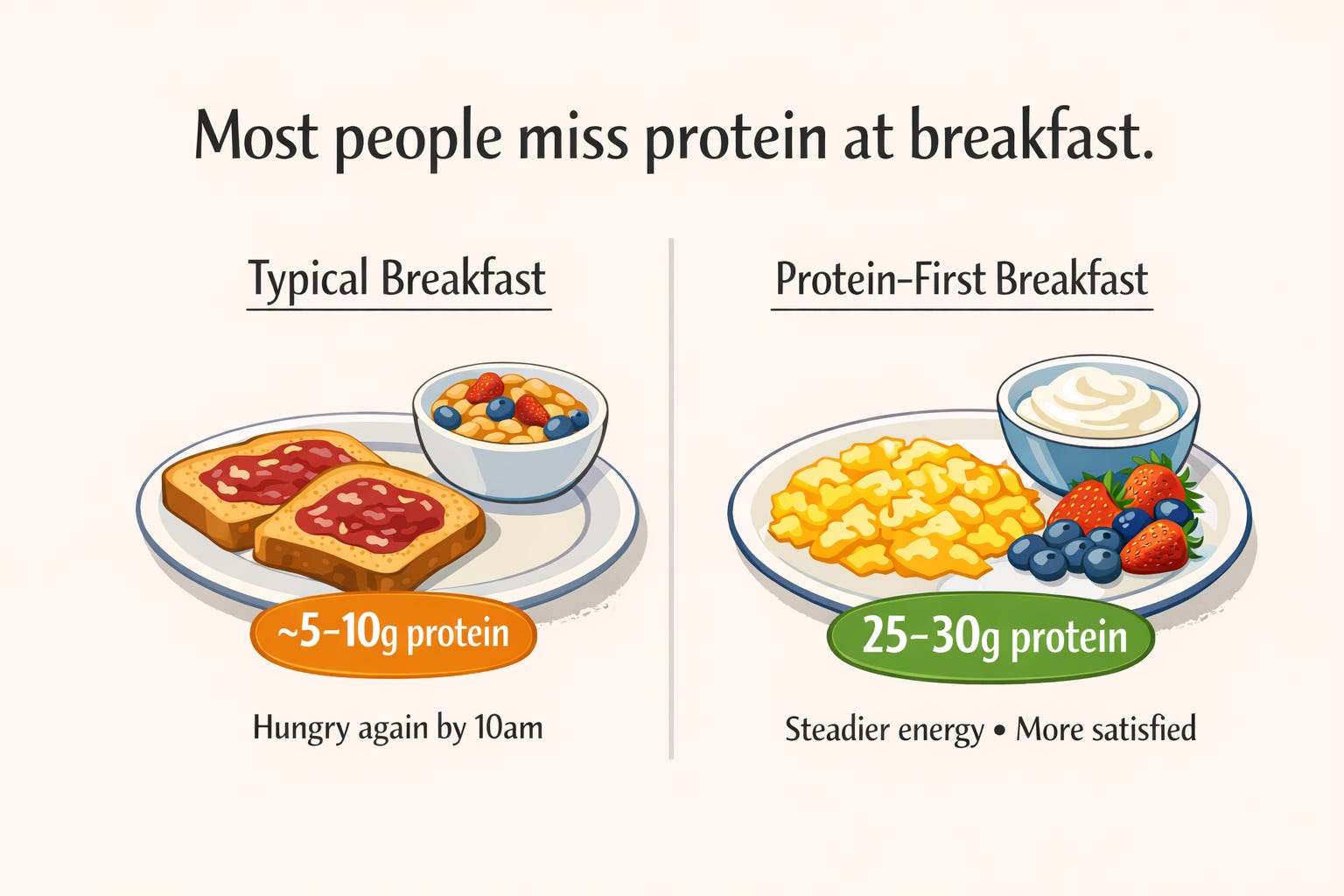
Most people do the opposite. They eat toast, cereal, or a muffin—foods that are almost entirely carbohydrates. Then they wonder why they’re hungry again by 10 a.m. and reaching for snacks.
Starting your day with 25-30 grams of protein changes your entire morning. You feel satisfied longer. Your energy stays steady. Your muscles get what they need to maintain themselves.
Evening Protein Helps Overnight Repair
This one surprises people. A small protein snack before bed—around 15-20 grams—gives your body amino acids to work with during sleep, when most muscle repair happens.
Studies show that protein before bed improves overnight muscle protein synthesis without interfering with sleep or causing weight gain.
Good options: half a cup of cottage cheese (about 12-14 grams), a small Greek yogurt (15 grams), or a glass of milk (8 grams). Keep it simple and light. You’re not eating a meal, just providing building blocks for overnight repair.
Protein Around Movement
You don’t need protein immediately after exercise. That’s mostly a myth perpetuated by supplement companies. But having protein within a few hours of any movement—even just a long walk—helps your muscles recover and adapt.
If you take a morning walk, having protein at breakfast works. If you exercise in the afternoon, having protein at lunch or dinner covers you. The timing doesn't need to be exact, just reasonably close.
Not All Protein Works The Same Way In Your Body
Animal Versus Plant Protein
Your body digests and absorbs animal protein more completely than plant protein. This is about biology, not judgment.
Animal proteins contain all nine essential amino acids in ratios that match what your body needs. Plant proteins often lack one or more essential amino acids, or contain them in smaller amounts. This doesn’t mean plant proteins don’t work—they do—but you need to eat more of them or combine different plant proteins to get the same benefit.
Research comparing protein sources in older adults shows that animal proteins are more effective gram-for-gram at maintaining muscle mass.
If you eat animal products, this is straightforward. If you’re vegetarian or vegan, you need to be more intentional about combining proteins and eating larger total amounts.
Which Proteins Your Body Absorbs Best
After 60, digestibility matters more than it did when you were younger. Your stomach produces less acid, which makes breaking down tough proteins harder.
Easiest to digest and absorb:
Eggs (especially if cooked, not raw)
Greek yogurt
Cottage cheese
Fish (particularly white fish like cod or tilapia)
Whey protein powder
Very good:
Chicken breast
Turkey
Lean beef
Pork tenderloin
Good, but requires more volume:
Beans and lentils (combine with rice or corn for complete protein)
Tofu and tempeh
Quinoa
Edamame
Better as additions than main sources:
Nuts and seeds
Whole grain bread
Vegetables
Notice that the easiest proteins to digest are also soft or tender. This isn’t coincidental. If chewing has become difficult, focus on the top category.
What Interferes With Protein Absorption
Common Medications
Some medications reduce your body’s ability to digest and absorb protein by reducing stomach acid. That’s their job. But stomach acid is crucial for breaking down protein
If you take these medications daily, talk to your doctor. Sometimes you can switch to a different medication or take it less frequently. Sometimes you need to stay on them, and then you adapt by choosing easier-to-digest proteins and possibly taking digestive enzymes with meals.
Low Stomach Acid
Even without medication, stomach acid production decreases with age. This makes protein feel heavy or cause bloating.
Signs you might have low stomach acid:
Feeling very full after eating protein
Bloating after meals with meat
Undigested food in your stool
Needing to eat smaller portions
What helps:
Eat smaller amounts of protein more frequently rather than large portions
Chew thoroughly—your teeth start the digestion process
Consider digestive enzymes with meals (papain, bromelain, or a complete enzyme blend)
Try easier-to-digest proteins like fish, eggs, and Greek yogurt
Dental Problems
Missing teeth or poorly fitting dentures make eating protein difficult. Meat becomes hard to chew. So people avoid it and shift to softer foods, which tend to be carbohydrate-based—bread, mashed potatoes, pasta.
This creates a cycle. Less protein leads to muscle loss, including in the jaw muscles. Weaker jaw muscles make chewing even harder. The problem compounds.
Soft proteins that work with dental challenges:
Scrambled eggs or egg salad
Cottage cheese
Greek yogurt
Canned tuna or salmon mixed with mayo
Soft-cooked fish
Ground meat in sauce
Refried beans
Smooth protein shakes
Soft tofu in soup
These aren’t lesser options. They provide the same protein quality as tough meat. An egg has the highest-quality protein of any food.
Clearing Up Protein Myths That Hurt Seniors
“Too Much Protein Damages Your Kidneys”
This myth comes from outdated advice. If you already have kidney disease, your doctor will give you specific protein guidelines. For people with healthy kidneys, higher protein intake is not harmful.
Multiple studies on older adults eating high-protein diets show no negative effects on kidney function. In fact, adequate protein helps maintain kidney health as you age.
The confusion comes from a misunderstanding of how kidneys work. Yes, kidneys process protein waste products. But healthy kidneys handle this easily. It’s what they’re designed to do.
If you have any concerns about kidney health, ask your doctor to check your kidney function with a simple blood test. If your kidneys are healthy, you don’t need to restrict protein.
“Protein Makes You Gain Weight”
Protein is actually the most difficult macronutrient for your body to store as fat. It’s also the most satiating—meaning it keeps you full longer than carbohydrates or fat do.
Research consistently shows that higher protein diets help with weight management in older adults, not weight gain.
When people gain weight while eating more protein, it’s usually because the protein comes with large amounts of other calories—a chicken breast is fine, but a chicken breast with a large serving of pasta, breadsticks, and dessert is a lot of calories.
The protein itself helps you feel satisfied, which typically leads to eating less overall.
“You Need Expensive Protein Powder”
Whole foods work fine for most people. Eggs, chicken, fish, Greek yogurt, cottage cheese—these provide everything your body needs.
Protein powder makes sense in specific situations:
You have no appetite and liquids go down easier
You have dental problems that make chewing difficult
You need something quick and portable
You struggle to meet your protein needs with regular food
If you do buy protein powder, whey protein is most effective for muscle maintenance in older adults. It’s absorbed quickly and has high leucine content. If you’re lactose intolerant or vegan, look for a blend of plant proteins (pea, rice, hemp) rather than a single source.
You don’t need fancy brands or expensive formulations. Plain whey protein or a simple plant protein blend works fine.
Solving Real Protein Problems
“I’m Just Not Hungry For That Much Food”
Appetite often decreases after 60. This is common and creates a real problem—you need more protein per meal, but you want less food overall.
Strategies that work:
Make liquids count. A protein smoothie with Greek yogurt, milk, a banana, and a scoop of protein powder can give you 30-35 grams in a drinkable form. Much easier than eating when you’re not hungry.
Enrich foods you already eat. Stir protein powder into oatmeal. Make scrambled eggs with extra egg whites. Use Greek yogurt instead of sour cream. Use milk instead of water in soup. These small additions add up without feeling like more food.
Eat smaller amounts more often. Instead of three large meals, eat five smaller ones. Fifteen grams of protein five times a day gets you to 75 grams total, which is adequate.
Choose dense protein sources. Three ounces of chicken provides the same protein as a cup and a half of beans, but takes up less space in your stomach.
“Meat Is Expensive”
Protein doesn’t require expensive cuts of meat.
Budget-friendly protein sources:
Eggs: About 25 cents per egg, 6 grams of protein. Five eggs scrambled = 30 grams for $1.25.
Canned tuna or salmon: Often $1-2 per can, 20-25 grams of protein per can.
Rotisserie chicken: $5-7 gives you enough chicken for 4-5 meals worth of protein.
Ground turkey: Usually cheaper than ground beef, same protein content.
Cottage cheese: Large container is $3-4, each cup has 25 grams of protein.
Dried beans: Extremely cheap. One cup cooked has 15 grams protein. Combine with rice for complete protein.
Greek yogurt: Store brands are affordable and have the same protein as name brands.
Chicken leg quarters: Often 59-99 cents per pound. Dark meat has the same protein as white meat.
Canned beans: Already cooked, 50-80 cents per can, easy to add to any meal.
Shopping strategies: Buy meat when it’s on sale and freeze it in single-serving portions. A family pack of chicken breasts can be divided into individual pieces, frozen flat in bags, and pulled out as needed.
Store brand proteins are identical nutritionally to name brands for Greek yogurt, cottage cheese, eggs, and canned fish.
Focus on protein at meals, not expensive snack foods. The money you save by not buying chips, cookies, and crackers can go toward better protein sources.
“I’m Vegetarian Or Don’t Like Meat”
You can absolutely get enough protein without meat. It requires more planning, but it works.
The key is combining different plant proteins so you get all essential amino acids, and eating larger total amounts since plant proteins are less efficiently absorbed.
Complete plant protein combinations:
Rice and beans (any type of each)
Peanut butter on whole wheat bread
Hummus with pita bread
Lentil soup with a roll
Tofu stir-fry with rice
Bean burrito in a whole wheat tortilla
High-protein plant foods:
Lentils: 18 grams per cooked cup
Chickpeas: 15 grams per cooked cup
Black beans: 15 grams per cooked cup
Tofu: 10 grams per half cup
Tempeh: 15 grams per half cup
Edamame: 17 grams per cup
Quinoa: 8 grams per cooked cup
If you eat dairy and eggs: This makes it much easier. Greek yogurt and eggs are two of the highest-quality proteins available. Two eggs plus a cup of Greek yogurt gives you 27 grams of complete protein.
If you’re fully vegan: Aim for about 30-35 grams of plant protein per meal to account for lower absorption rates. A meal might include a bean-based dish plus quinoa plus some nuts or seeds.
Plant-based protein powder can help fill gaps on days when eating enough whole food protein feels difficult.
“Preparing Protein Is Too Much Work”
Some days cooking feels impossible. You need options that require zero or minimal preparation.
No-cook proteins:
Pre-cooked deli meat (turkey, chicken, ham)
Canned tuna or salmon, eaten straight from the can or mixed with mayo
String cheese or cheese slices
Greek yogurt
Cottage cheese
Hard-boiled eggs (boil a dozen at once, they keep for a week)
Protein shake
Rotisserie chicken from the grocery store
Minimal-prep proteins:
Frozen pre-cooked chicken strips—just heat in microwave
Frozen fish fillets—12 minutes in the oven
Scrambled eggs—5 minutes start to finish
Can of beans, rinsed and heated
Frozen pre-cooked shrimp—defrost under cold water, ready in 5 minutes
Batch cooking strategy: Once a week, cook a large batch of protein. Grill or bake six chicken breasts at once. Cook two pounds of ground turkey with taco seasoning. Bake a whole tray of salmon. Divide into individual portions and freeze.
Then on busy days, you pull out a portion, heat it, and add simple sides. The protein is done.
This doesn’t require being a good cook. Set your oven to 375°F, put seasoned chicken breasts on a baking sheet, cook for 25 minutes. Done.
The One-Week Protein Test
Before changing anything, see where you actually are.
Days 1-3: Track What You’re Eating Now
You don’t need an app. Just write down protein-containing foods and estimate the grams.
Quick reference for estimating:
Palm-sized piece of meat, chicken, or fish = 25-30 grams
One egg = 6 grams
One cup Greek yogurt = 15-20 grams
Half cup cottage cheese = 12-14 grams
One cup cooked beans = 15 grams
One tablespoon peanut butter = 4 grams
One ounce cheese = 7 grams
One cup milk = 8 grams
Write down each meal:
Breakfast: [foods] = approximately [X] grams protein
Lunch: [foods] = approximately [X] grams protein
Dinner: [foods] = approximately [X] grams protein
Snacks: [foods] = approximately [X] grams protein
If you're not sure how much protein is in specific foods, Cronometer.com is a free website and app that shows detailed nutrition information. Just type in the food and amount, and it tells you exactly how much protein it contains. The free version works perfectly fine for tracking protein.
After three days, you’ll see your pattern. Most people discover something like: 10-15 grams at breakfast, 15-20 grams at lunch, 35-45 grams at dinner.
That uneven distribution is the problem. Your body can’t effectively use all that dinner protein when the earlier meals were insufficient.
Days 4-7: Try The 25-25-25 Pattern
Aim for 25-30 grams at each of your three main meals. Track the same way you did for the first three days.
For example:
Breakfast (27 grams): Two eggs scrambled with cheese (15 grams) plus Greek yogurt with berries (12 grams)
Lunch (28 grams): Tuna salad made with one can of tuna (22 grams) on whole grain bread, plus a string cheese (6 grams)
Dinner (30 grams): Grilled chicken breast (25 grams) with roasted vegetables and a small side salad with chickpeas (5 grams)
Total: 85 grams, distributed evenly
What To Notice
Pay attention to how you feel during this week compared to your normal eating pattern.
Energy levels: Do you feel steady energy throughout the day, or do you crash between meals?
Hunger: Are you satisfied between meals, or constantly looking for snacks?
Sleep: Are you sleeping better or worse?
Physical feelings: Do you notice any difference in how your body feels when moving—getting out of chairs, climbing stairs, carrying groceries?
Digestion: Does the protein feel heavy, or does it settle fine?
One week isn’t long enough to build muscle or see major changes, but it is long enough to notice whether this eating pattern works for you. If it does, keep going. If something doesn’t work, adjust that part.
What This Actually Means For Your Life
Numbers on a page don’t mean much unless they translate to real outcomes in your daily life.
Adequate protein after 60 directly affects:
Your strength. Maintaining muscle mass means you can continue doing the physical tasks you need to do—carrying groceries, getting out of a bathtub, opening jars, walking up stairs without your legs feeling shaky.
Your balance. Muscle strength, especially in your legs and core, keeps you stable. Falls are one of the biggest threats to independence after 60. Strong muscles prevent falls.
Your recovery from illness. When you get sick or have surgery, your body needs protein to heal and rebuild. People who eat adequate protein recover faster and maintain more function during illness.
Your metabolism. Muscle tissue burns more calories at rest than fat tissue does. Maintaining muscle helps maintain your metabolic rate, which makes weight management easier.
Your independence. The ability to live in your own home, take care of yourself, and do the activities you enjoy depends on physical capability. Physical capability depends on maintaining muscle. Muscle depends on protein.
This isn’t about vanity or achieving an athlete’s physique. It’s about having the physical strength to live the life you want for as long as possible.
Studies following older adults over time show that those who maintain muscle mass have lower risks of falls, hospitalization, disability, and death. Protein intake is one of the most controllable factors in maintaining that muscle.
Starting Where You Are
Pick one meal to focus on this week. Just one.
Maybe you’ll add protein to breakfast. Maybe you’ll increase lunch protein. Maybe you’ll prepare hard-boiled eggs on Sunday to have quick protein available all week.
One change. See how it feels. Notice whether you feel more satisfied, whether your energy stays steadier, whether that meal keeps you full longer.
If that change works, keep it and add another small change next week. If it doesn’t work, try something different.
You’re not following a rigid meal plan. You’re gradually adjusting your eating in a direction that supports your body better. Small changes that you can actually maintain matter more than perfect eating that lasts three days before you give up.
The goal is getting more protein into your day in ways that work for your life, your budget, your cooking abilities, and your food preferences. Everything else is details.
What’s your biggest challenge with getting enough protein? Share in the comments below!


I am 80, fit, active and well. My daily breakfast is high in protein, low carb, high fibre and good oils:
Mixed berries 100g
Barley flakes 15g
Stewed apple 100g
Mixed seeds 75g
Pear 150g
Yogurt or Kefir 100g
Coffee 2 cups
This keeps me going for 4 or five hours
Very informative article! Thank you! I am beginning to pay attention to protein intake. Im 79 (and 12 days...but who's counting!) 🤗 biggest stumble for me is wicked gas with dairy, legumes and eggs. I have protein powder for smoothies but I get going 99mph and forget to eat (and hydrate.) Ive got lots of work to do to find a more reasonable speed and thus find time to eat more!
Thank you again!