

Pickleball: Why This Sport Actually Makes Sense for Bodies Over 60 (Not Just for the Reasons You've Heard)

You probably heard about pickleball. Probably more than once, from more than one person, with more enthusiasm than you asked for. Maybe a neighbor mentioned it. Maybe you saw a piece on the news about how it’s the fastest-growing sport in America. Maybe someone your age came back from a trip talking about it like they’d found religion.
And your reaction — reasonably — was somewhere between mild curiosity and mild eye-roll.
That’s fair. The marketing around pickleball for seniors tends to be aggressively cheerful. “Low-impact!” “So easy to learn!” “You’ll love it!” None of which addresses the actual questions an adult over 60 might have: Will this hurt my knees? Am I going to feel foolish? Is this just shuffleboard with a paddle?
This piece isn’t going to tell you it’s wonderful and you should try it. It’s going to make a structural case — court size, ball physics, net height, play culture — for why this particular sport happens to fit older bodies in ways that most social sports don’t. The hype is separate from the sport. The sport is worth looking at clearly.
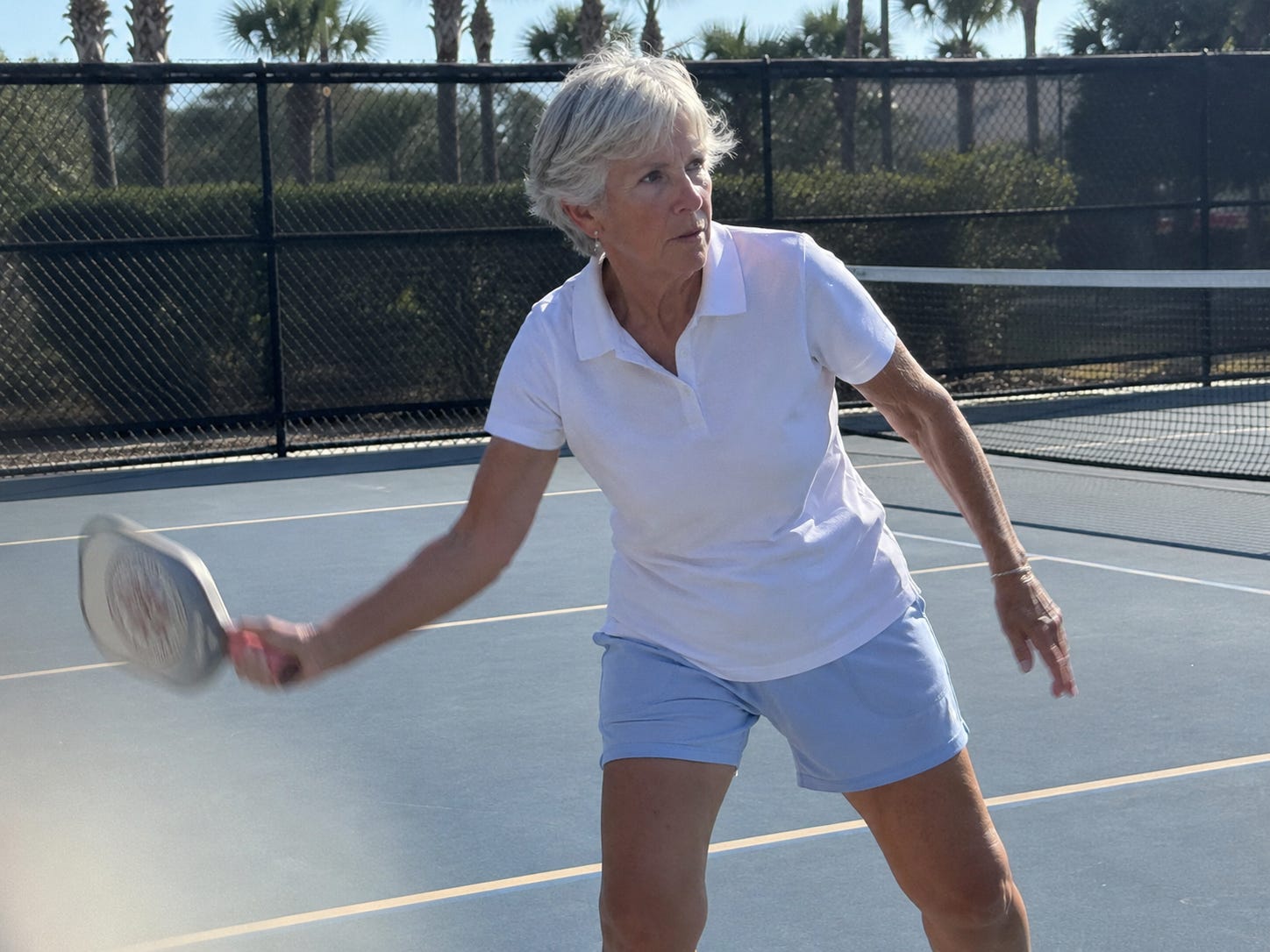
Why Every Sport Feels Harder After 60 — and Why Pickleball Is Different
Here’s what happens to athletic tolerance as we age: it’s not that we get weaker in some dramatic way. It’s that the margin for error shrinks. Recovery takes longer. High-impact surfaces accumulate in joints in ways they didn’t at 40. The window between “warming up” and “overdoing it” narrows.
Most sports aren’t built for that margin. Tennis demands explosive lateral movement on a court that’s 78 feet long. Golf is low-impact but hard on the lumbar spine and requires equipment mastery that takes years to develop. Running is wonderful until it isn’t. Group fitness classes often move at a pace set by instructors half your age.
Is pickleball good for seniors? It’s worth asking seriously, not rhetorically.
A pickleball court is roughly one-third the size of a tennis court — 20 by 44 feet. That’s not an accommodation. That’s the actual game. The ball is made of lightweight perforated plastic and travels significantly slower than a tennis ball. The serve is underhand, which eliminates the rotator cuff strain that sidelines a large percentage of recreational tennis players. The net is slightly lower in the middle than at the sides, which changes the geometry of shots in ways that reward placement and patience over power.
None of these features were designed for older bodies specifically. They’re just the rules. But they happen to match the biomechanics of a body that has been alive for six or more decades — reduced reaction time requirements, smaller court means less ground to cover, slower ball means more time to process and position.
That’s the structural argument. It’s not inspirational. It’s just geometry and physics working in your favor for once.
The Benefits of Pickleball for Older Adults — What the Research Actually Says
Let’s skip the list of twelve benefits and stay with what actually matters.
Cardiovascular health. A study from the Chapman University research group, referenced widely in sports medicine literature, found that recreational pickleball players improved their cardiorespiratory fitness, blood pressure, and cholesterol levels after six weeks of play three times per week. The Cleveland Clinic has cited pickleball as a legitimate form of moderate-intensity aerobic exercise — which is the category most cardiologists recommend for adults over 60 who aren’t in cardiac rehab. You’re not sprinting. You’re sustaining effort, which is exactly what a heart needs.
Balance and fall prevention. This is the one that matters most, statistically. Falls are the leading cause of injury-related death in adults over 65 — a pattern consistent across the US, UK, Canada, and Australia. What prevents falls isn’t primarily strength — it’s proprioception, the body’s ability to sense where it is in space and make micro-corrections in real time. Playing pickleball requires constant weight shifting, small lateral steps, and hand-eye coordination that directly trains proprioceptive pathways. If you’ve read anything about why ankle strength is the often-overlooked key to stability, you’ll recognize the mechanism. The court becomes a low-stakes training environment for the neuromuscular skills that prevent falls off the court.
Loneliness and isolation. A 2025 national survey on social connectedness found that adults who participated in recreational group sports reported significantly lower rates of chronic loneliness than age-matched peers who exercised alone. Pickleball in particular has an unusual social structure: most community play happens in “open play” sessions where strangers rotate partners and opponents. You don’t need a regular partner. You don’t need to know anyone. You show up and you’re in. For adults navigating post-retirement identity, the loss of a work social network, or the particular ache of an empty house, that default inclusion matters more than it sounds.
On pickleball and joint health specifically. Low-impact does not mean zero-risk. That distinction is important. The most common injuries in pickleball are Achilles tendon strains (from sudden stops), wrist injuries (from falls on an outstretched hand), and knee pain (from repetitive lateral movement without proper warmup). These are real. But compared to tennis, which has higher rates of shoulder and elbow injury due to overhead serving and topspin mechanics, pickleball’s injury profile is measurably lower. A 2023 study in the Journal of Emergency Medicine found that while pickleball injuries are increasing in absolute numbers (because participation has increased), the rate of injury per player-hour remains lower than most racquet sports.
The honest framing of the benefits of pickleball for older adults: it provides moderate cardiovascular exercise, proprioceptive training that supports balance, and a social structure that reliably produces connection — with an injury profile that compares favorably to the alternatives. That’s a reasonable case.
How to Start Playing Pickleball Over 60 Without Hurting Yourself or Hating It
The practical part. Sequenced deliberately.
Find courts first. The USA Pickleball website (usapickleball.org) has a court finder by postcode or zip code. Most recreation centers, community sports facilities, and public parks in mid-sized cities now have dedicated pickleball courts. Many converted from underused tennis courts.
Choose open play over leagues. “Open play” is the format where anyone can show up, no partner required, and games rotate every 11 points. It’s how most people over 55 play. Leagues require a regular schedule and an assumed skill level. Open play does not. The culture at open play sessions is — anecdotally and by consistent report — welcoming to beginners in a way that is not universally true of other recreational sports. Part of this is because most people there are also relatively new. Part of it is that the sport is young enough that everyone remembers being a beginner.
Equipment: keep it simple. One paddle recommendation that won’t steer you wrong: any mid-weight graphite paddle in the mid-range price bracket (roughly $50–90 USD or equivalent) from a brand like Selkirk, Paddletek, or ONIX. Do not spend $200 on your first paddle. The paddle is not what determines whether you have a good first session. Shoes matter more than most people realize — regular sneakers don’t provide the lateral support pickleball demands. A court shoe or a tennis shoe works; running shoes typically don’t, because their heel cushion works against lateral stability.
First-session expectations. You will not be good. That is not a problem, and it is not a reason to stay home. The learning curve in pickleball is faster than tennis — most beginners can sustain a rally within the first two sessions. The underhand serve is easier than it sounds. The “kitchen” (the non-volley zone near the net) will confuse you for a few sessions; that’s also true for everyone. Expect to spend the first session watching the ball and laughing at yourself. That’s the correct first session.
The two-sessions-per-week rule for the first month. Tendons adapt more slowly than muscles. Your cardio might feel fine after week one, but your Achilles and your wrist flexors need time to catch up to what you’re asking of them. Two sessions per week for the first four weeks, 60-90 minutes maximum, is the physical therapist’s recommendation — not because you can’t handle more, but because the connective tissue adaptation that prevents injury happens in rest, not in play.
On being the oldest or slowest: The majority of new pickleball players — in the US, Canada, and increasingly across Europe and Australia — are between 55 and 75. You are not the exception in the demographic. You are the demographic.
When you show up to open play, you will most likely be assigned a partner, play a short game, shake hands, and rotate. Someone will probably explain the kitchen rule twice because they were confused at first too. If your community has a strong open play scene, you will likely see the same people week after week. That’s how it becomes a thing you do rather than a thing you tried once.
Enjoying this? Plus members get exclusive Sunday deep-dives, a printable 60-page Fun Pack every month, and full library access. $10/month or $97/year.
The Honest Part: What Pickleball Actually Does to Your Body After 60
What actually hurts. The Achilles tendon is the most common serious injury in pickleball across all ages, but particularly in adults over 60. It happens during the stop-start movement that the kitchen zone requires — you chase a drop shot, plant, and the tendon is loaded suddenly. Warming up genuinely prevents this. Not a symbolic two-minute stretch, but a real 10-minute warmup that includes calf raises, lateral shuffles, and wrist circles. The research on dynamic warmup before racquet sports is consistent: it reduces soft tissue injury rates by 30-50%.
Wrist injuries are the second category, and they’re almost always from falls. The instinct when you fall is to put your hands out. That instinct is correct for protecting your head; it’s hard on the wrist. If you’ve had any previous wrist issues or bone density concerns, a wrist brace during play is not dramatic — it’s sensible.
The mental shift worth making. Most people over 60 approach a new physical activity with the framing: “I need to get fit enough to do this.” That framing is backwards for pickleball. You don’t need to be fit first. Playing is how you get fit. The fitness is a byproduct, not a prerequisite. This is similar to what we’ve written before about movement as something you do because it feels good, not as penance for not being in better shape. Pickleball just gives the movement a reason that isn’t “my doctor said so.”
The gender note. Pickleball skews female in the 60-plus demographic, by a meaningful margin. Women navigating retirement, the end of caregiving roles, the particular social loss that comes with an empty nest or a spouse’s death — they have found in pickleball something that most fitness recommendations don’t offer: a sport that doesn’t require a partner, doesn’t punish aging bodies, and generates a community of peers without requiring vulnerability to create it. You show up. You play. The connection happens in the margins. It’s not something you have to manufacture.
What the research doesn’t capture. The data on cardiovascular improvement and balance is real. But there’s something that happens in the third or fourth week of play that isn’t in the studies: you stop thinking about the rules and start thinking about the game. And then at some point, you stop thinking about the game and start thinking about lunch plans with the people you’ve been playing with. That’s the part that makes people keep going.
If you want context on how balance specifically changes when you add a movement practice, the balance test is a good place to understand where you’re starting from. Pickleball will move those numbers.
The Case, Without the Hype
You were right to be skeptical of the enthusiasm. Hype is a reasonable thing to distrust, and pickleball has been marketed with a cheerfulness that mostly serves to make thoughtful people suspicious.
But the sport itself isn’t the marketing. The sport is a small court, a slow ball, an underhand serve, and a culture of open play that was built by and for adults who didn’t want to negotiate a partner or commit to a league just to get outside and move.
It happens to fit bodies over 60 well. Not because it was designed for them, but because its physics and structure align with what those bodies actually need — sustainable effort, manageable impact, something social that doesn’t require performing energy you don’t have.
Here’s the lowest-stakes version of a call to action: look up one open play session in your area this week. Go once. Not to commit. Not to become a pickleball person. Just to see what it actually is, separate from the hype you’ve already heard.
You might not love it. But you might love it more than you expected. And that, given everything, seems worth finding out.
Have you tried pickleball? I'd genuinely love to know how it went — or what's still holding you back.
Wow…so much information! I’ve been playing for several years …indoors and out… courts are everywhere. Recreational for those of us in 70-80s. Great fun and easy to learn. There are places, times, and rules for competitive players! Court shows, protective eyewear and no runnung backward are my sufgestions for seniors! Im 82 and love it. League play is 90 minutes of back to back games… really increased my stamina! I only do open play now for the fun and so much laughing! Thanks for sharing this ….great reading for anyone considering! 🙌👍😊
An orthopedic surgeon who lives in my building said that pickleball would make him a multimillionaire because of how many older people get seriously injured playing it. I don’t agree completely with your assessment.