

Light Switches, Doorknobs, and Faucets: Small Changes That Make Life Easier

You’re carrying a basket of laundry down the hall. You reach your bedroom door, but that round doorknob won’t turn unless you set everything down first.
Or maybe it’s 2 AM and you’re heading to the bathroom. You fumble for the light switch in the dark, your stiff fingers struggling to grip that small toggle and flip it up.
Or you’re at the kitchen sink, hands covered in raw chicken juice, trying to turn on the faucet. Your wet fingers slip off those round knobs. Once. Twice. Three times before you finally get the water running.
These aren’t dramatic problems. Nobody’s going to write a news story about your struggle with a doorknob. But these moments happen twenty, thirty, maybe forty times every single day. And when your hands hurt—when your grip isn’t what it used to be—each one of these tiny struggles chips away at your independence.
You don’t have to live like this.
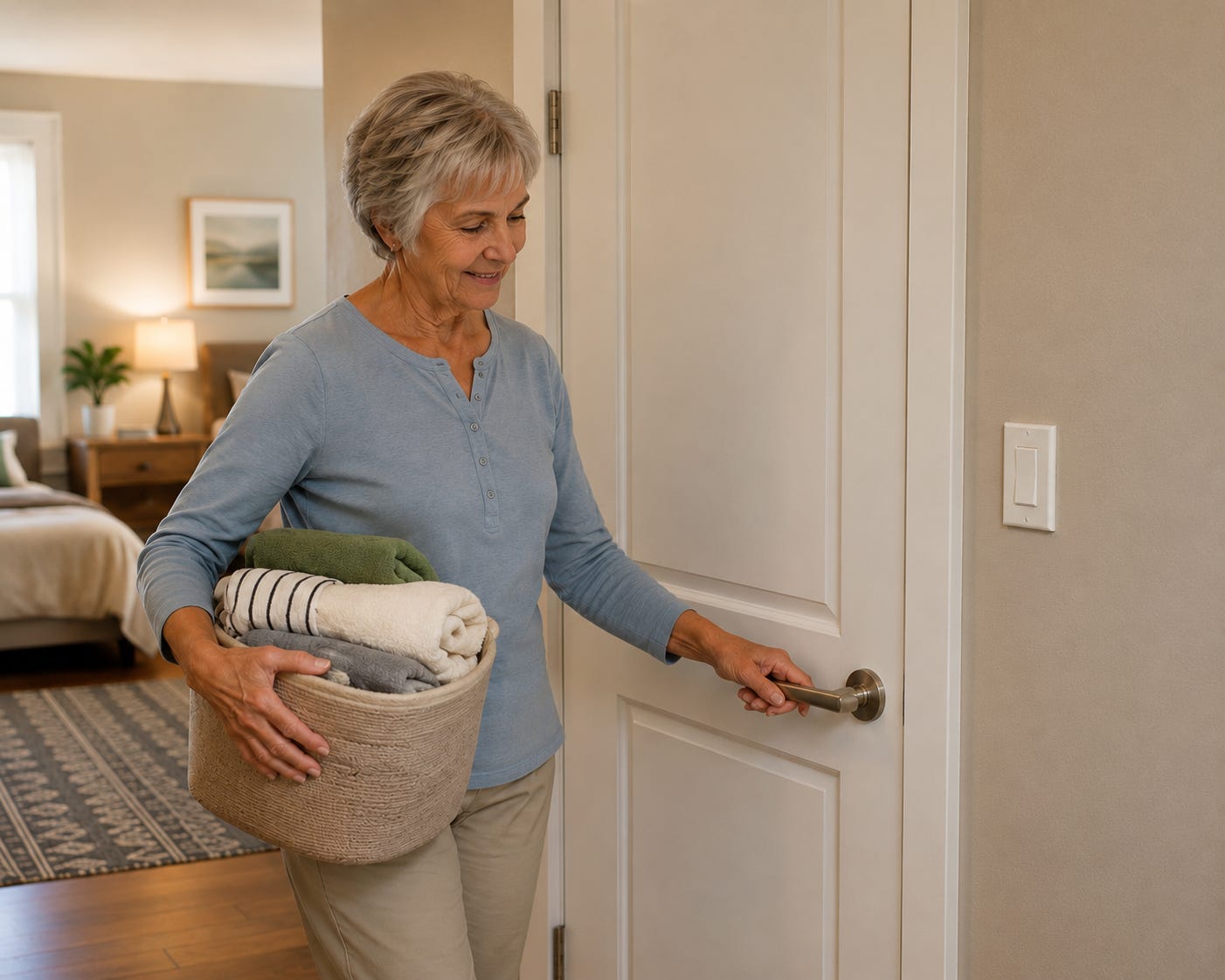
Simple swaps—not renovations, not major construction projects—can make these everyday tasks effortless again. You can hire someone to install them for you, or tackle them yourself if you’re handy. And they change your daily life immediately.
Let me show you what actually works.
We also covered Five Simple Bathroom Changes That Prevent Falls and Making Your Home Work: The Front Door and Entry in previous posts; you might want to check those out as well.
These Small Changes Will Actually Make a Difference
Arthritis affects millions of adults worldwide. If you’re over 65, your grip strength has likely declined by 20 to 40 percent compared to your younger years. Activities that require twisting, pinching, or tight gripping become painful. Then they become something you avoid.
But the real issue isn’t just the pain.
When you can’t easily turn on lights, you’re at higher risk of falling in the dark. When operating the faucet is a struggle, you skip washing your hands or don’t drink enough water. When you can’t quickly open doors, you’re trapped in a room during an emergency. When you start avoiding tasks because they hurt, you lose even more strength and independence.
It’s a cascade. And it happens slowly enough that you don’t notice until suddenly you realize you’ve been asking your spouse or kids for help with things you used to do without thinking.
I know what you might be thinking. “I can still do it, it just hurts a little.” Or “I don’t want my house to look like a nursing home.” Or maybe “Making these changes feels like giving up.”
These modifications help everyone, not just seniors. Parents holding babies love lever door handles. People recovering from injuries need rocker switches. Anyone carrying groceries appreciates a faucet they can turn on with their elbow. It’s called “universal design” for a reason—it makes life easier for all humans.
This isn’t about giving up. It’s about refusing to suffer when simple solutions exist.
Enjoying this? Plus members get exclusive Sunday deep-dives, a printable 60-page Fun Pack every month, and full library access.
Light Switches: The Easiest Change You Can Make
Let’s start with the simplest modification: light switches.
Traditional toggle switches require you to pinch that small lever between your fingers and flip it up or down. When you have arthritis or weak hand muscles, that pinching motion hurts. The target is small. In the dark, you fumble for it. And if the switch is stiff—which older switches often are—you need strength you might not have anymore.
The better option: Rocker switches (also called paddle switches or decorator switches).
Instead of a small toggle you pinch, rocker switches give you a large, flat panel. You press anywhere on that panel with your palm, your fist, your elbow, or even your shoulder. There’s no gripping. No pinching. You can operate them even if you’re holding something in both hands. The target area is much larger, making them easier to find in the dark.
What to look for when you shop:
Look for switches labeled “rocker switch,” “paddle switch,” or “decorator switch.” Make sure they’re ADA-compliant—that’s a good sign they’re designed for accessibility. Consider illuminated versions that glow in the dark for even easier nighttime navigation. And match your current color: white, ivory, almond, or whatever finish you have now.
You can find them at hardware stores, home improvement centers like Home Depot or B&Q, or online.
For installation, an electrician can replace switches throughout your home in a few hours. A handyman can handle this job as well. If you’re comfortable doing basic electrical work yourself, each switch takes about 15 minutes.
Which rooms should you prioritize?
Start with your bathroom. That’s where most falls happen, and being able to quickly turn on lights prevents accidents. Next, tackle your bedroom for safe nighttime access. Then do hallways since you use them frequently.
If you want to go a step further, consider motion-sensor switches for your bathroom. Wave your hands and the light turns on—no touching required. Timer switches are another option that automatically shut off after a set time. These add convenience, but the basic rocker switch alone will make a huge difference in your daily life.
Doorknobs: Why Round Handles Need to Go
Now let’s talk about doorknobs. Specifically, round doorknobs.
Round doorknobs are a problem. They require grip strength AND a twisting motion—that’s a double dose of pain if you have arthritis. Try opening one with wet hands and you’ll slip right off. Try opening one when you’re carrying something and you literally can’t do it. And in an emergency—a fall, a fire, a medical crisis—round knobs can prevent you from exiting a room quickly.
The better option: Lever handles.
Lever handles are L-shaped. Instead of gripping and twisting, you simply push down. You can operate them with a closed fist, your elbow, your forearm, or even your hip if your hands are completely full. They’re ADA-compliant for accessibility. The downward pushing motion uses gravity, which is much easier than twisting. You can open a door without any grip strength at all. And in an emergency, you can exit much faster.
Three types of lever handles you need to know about:
Interior passage levers are for bedrooms, closets, and hallways—anywhere you don’t need a lock. They’re the simplest option with no lock mechanism.
Privacy levers are designed for bathrooms. They have a lock button on the inside and an emergency release on the outside. That emergency release is critical—if someone falls in the bathroom, you need to be able to get in quickly.
Entry levers are for your front door, back door, and garage entry. They have keyed locks. This is arguably your most important change because it directly affects your ability to come and go from your home freely.
When shopping, look for:
Long levers—5 to 6 inches gives you maximum leverage. Choose solid metal, not hollow plastic that will break. Make sure the grip texture feels comfortable in your hand. And pick a finish that matches your existing hardware so your home looks cohesive.
For an average home, you’ll need handles for 6 to 8 interior doors, 1 to 2 bathroom doors, and 1 to 2 entry doors.
You can buy these at any hardware store where you can feel them in person, at home improvement centers for good selection, or online. Schlage is durable and widely available. Kwikset offers good value. Baldwin is the premium option.
See lever door handles on Amazon
For installation, a handyman can handle this job or a locksmith for entry doors with locks. If you’re comfortable with basic tools, installation takes about 30 minutes per door.
Priority order matters:
First, change your bathroom door handles. Safety comes first—you must be able to exit quickly if something goes wrong. Second, change your front door. This is about independence and your ability to come and go freely without struggling. Third, do your bedroom so you can access your personal space without help. Then do everything else as your budget allows.
One common question: “Won’t lever handles open if my dog or cat jumps on them?”
Yes, possibly. You can buy door lever locks, install the handle slightly higher than standard, or train your pets. But even with that small risk, lever handles are still worth it for your independence and safety.
Faucets: The Change That Affects Your Life Most
Of all the modifications we’re discussing, faucets might have the biggest impact on your daily life. Think about how often you use a faucet. Washing hands, getting water to drink, washing dishes, washing vegetables, cleaning up. Dozens of times every day.
Twist-knob faucets require grip strength plus rotation—the most painful motion for arthritic hands. If you have a two-handle faucet, you need both hands working. And when your hands are wet and soapy, your fingers slip off those smooth knobs constantly.
The result? People skip washing their hands because it hurts too much. They avoid cooking because they can’t manage the kitchen faucet. They don’t drink enough water because getting to it is a struggle.
Let’s fix that.
Option 1: Single-lever faucets—the best choice for most people.
A single-lever faucet has ONE handle that controls both temperature and water flow. Push the handle up and down to control water pressure. Push it left and right to adjust temperature. You can operate it with your palm, wrist, or forearm. There’s no twisting motion at all. You can use it even with soapy hands. And it’s one-handed operation, which means you can hold a pot or dish in your other hand.
For kitchen faucets, look for:
Models with a pull-down sprayer feature—it makes rinsing dishes and vegetables much easier. Choose a high-arc spout so you can easily fit pots underneath. And before you buy, measure your sink. Some have a single hole, others have three holes. You need to know which type you have.
Popular kitchen models include the Moen Arbor Single-Handle, the Delta Leland Single-Handle, and budget-friendly options from brands like Peerless.
See single-lever kitchen faucets on Amazon
Bathroom faucets are simpler since they don’t need sprayers. Just make sure the finish matches your other bathroom fixtures—chrome, brushed nickel, bronze, whatever you have. Popular bathroom models include the Moen Eva, the Delta Lahara, and budget options like Glacier Bay.
Option 2: Touchless or motion-sensor faucets—the ultimate in ease.
Touchless faucets turn on when you wave your hand under the spout. No touching required at all. They’re powered by batteries or plug into an electrical outlet under your sink. You need exactly zero grip strength. They’re more hygienic since you’re not spreading germs from dirty hands to the faucet handle. And you can operate them even when your hands are completely full.
But there are trade-offs. They’re more expensive. The sensors can malfunction over time. You need batteries or access to an electrical outlet under your sink. And some people find there’s a learning curve to getting the sensor to trigger reliably.
Touchless faucets are worth considering if you have severe arthritis or significant hand limitations, if you’re willing to invest more in your kitchen sink since that’s your most-used faucet, or if you simply want the most convenient option available.
Popular touchless models include the Moen Arbor Motionsense, the Delta Leland Touch2O, and the Kohler Sensate.
See touchless faucets on Amazon
Before you buy any faucet:
Measure your sink. A single-hole sink needs a single-hole faucet. A three-hole sink can use either type, but you might need a cover plate. If you have three holes, measure the spacing between them.
Look for these important features: ceramic disc valves last longer and leak less than other types. A high-arc spout is especially important in the kitchen. Check for an ADA-compliant label. If it’s a kitchen faucet, a pull-down sprayer adds major convenience.
Where to buy:
Home improvement stores let you see faucets in person and test the lever action. Online retailers typically offer more variety and customer reviews. Plumbing supply stores offer expert help if you have questions.
For installation, you’ll need a plumber to remove your old faucet and install the new one. A handyman might handle this if they’re comfortable with plumbing. I don’t recommend DIY for faucets unless you have plumbing experience—it’s one of those jobs that seems simple until something goes wrong.
Priority-wise:
Change your kitchen faucet first. It’s your most-used faucet and will have the biggest daily impact. Next, do your master bathroom since you use it for daily hygiene. Then tackle a guest bath if your budget allows.
Let me tell you about my mother’s friend. She stopped cooking for several months. We thought she was losing interest in food or maybe getting depressed. It turned out she had stopped cooking because she couldn’t turn the kitchen faucet knobs to wash vegetables. Her hands hurt too much. One lever faucet later, she was back to making Sunday dinners. Such a small change. Such a big impact.
Other Quick Upgrades Worth Considering
While you’re making changes, consider these additional modifications that solve specific problems:
Cabinet pulls instead of knobs
Round cabinet knobs require that same painful pinching grip we’ve been talking about. C-shaped or D-shaped pulls let you hook your fingers through them without any gripping at all. Priority: kitchen cabinets you use every single day.
Lever-style deadbolts
Thumb-turn locks hurt arthritic thumbs. Lever-turn deadbolts let you use your whole hand instead of just your thumb. Priority: your front door especially.
Extended toilet flush handles
Those small tank handles can be hard to push when you have hand pain. Extended lever handles give you more leverage. Priority: the bathrooms you use most frequently.
See extended flush handles on Amazon
Add-on refrigerator handles
If your refrigerator has recessed handles that need a strong grip, you can add stick-on or screw-on D-handles. Priority: if you’re struggling to open your fridge or freezer.
See refrigerator handles on Amazon
Large-display thermostats
Tiny dials and small buttons are hard to read and manipulate. Programmable thermostats with large screens and buttons are much easier. Priority: if you adjust your temperature frequently.
See large display thermostats on Amazon
You can find all of these at hardware stores, home improvement centers, or online retailers.
Your Action Plan
Step 1: The walk-through (do this week)
Grab a notebook and go through your home, room by room. Try every light switch—does it hurt your fingers? Try every doorknob—can you turn it easily with wet or soapy hands? Try every faucet—do you avoid using certain ones because they’re difficult? Open cabinets—are you pinching those knobs? Flush toilets—is it hard to push the handle?
Rate each one honestly. Is it fine? Uncomfortable? Does it hurt? Or have you started avoiding it entirely?
Step 2: Priority ranking
Safety first. Do these now: bathroom light switches, bathroom door handles, and bathroom faucets. Most falls and accidents happen in the bathroom. Getting these right could literally save your life.
Independence second. Do these within three months: your front door handle so you can come and go freely, your kitchen faucet for nutrition and hygiene, and bedroom light switches for safe nighttime access. These affect your daily dignity and health.
Comfort third. Do these as budget allows: all other light switches, all other door handles, cabinet pulls, and nice-to-haves like thermostats and toilet handles.
Step 3: Finding help
If you need installation, consider these options:
Handyman services can handle multiple types of installations. A local electrician is best for switches. A plumber is best for faucets. Or look for a “jack of all trades” handyman who can do everything in one visit.
If you need financial assistance, check with your local aging services agency. Some have assistance programs for home modifications. Veterans may have access to benefits that cover accessibility improvements. Some regions offer grants or low-interest loans for aging-in-place modifications.
To find local help, search online for “[your city] aging in place services” or “home modification services for seniors.” Contact your local senior center—they usually know who provides these services in your area.
What to Avoid
Common mistakes that waste time and money:
Buying the absolute cheapest option. Plastic breaks within months. Poor quality causes more frustration than the money you “saved.” Invest in quality that will last.
Trying to do everything at once. That’s overwhelming and expensive. Start with your bathroom because safety is the priority. Add more rooms as you have budget.
Forgetting to measure before buying. This is especially critical for faucets—you need to know if you have single-hole or three-hole sinks. For door handles, you need the correct backset measurement. Take photos and measurements with you to the store.
Ignoring your specific pain points. Some lever handles are still hard to use if they’re too thin or slippery. If possible, test them in the store. Read reviews that specifically mention “arthritis” or “easy grip.”
Thinking this is “giving up.” Athletes adjust their technique to prevent injury. That’s smart, not weak. Why should you suffer when solutions exist? This is about being practical and taking care of yourself.
The Bottom Line
You don’t need to renovate your entire house. You don’t need to move to assisted living. You don’t need to “just deal with it.”
Start with one room. Change one thing. See how much easier your day becomes.
These modifications aren’t just for seniors. They help people with arthritis at any age. Anyone recovering from injury. Parents holding babies. Anyone carrying groceries. It’s called universal design because it makes life easier for everyone.
Your home should work for you, not the other way around.
If your doorknobs hurt, change them. If your faucets are a struggle, upgrade them. If your light switches are hard to find in the dark, swap them out.
These aren’t big, dramatic changes. They’re practical solutions that let you keep your independence. They’re smart adaptations that reduce daily pain and frustration. They’re the difference between struggling through your day and moving through your home with ease.
I watched my mother resist these changes for months. She thought they made her look old. She thought they meant she was giving up. But after we made them, she told me something I’ll never forget: “I didn’t realize how much energy I was spending just trying to turn on a faucet or open a door. Now I can save that energy for things I actually want to do.”
That’s what this is really about. Not giving up. Not surrendering to age. It’s about refusing to waste your energy on things that could be easy. It’s about making smart choices that let you spend your time and strength on what actually matters to you.
So let me ask you: What will you change first?
Take your walk-through this week. Pick the one thing that bothers you most. Make that change.
You’ll be amazed at the difference.
*A note on product links:
The links throughout this article are provided to help you see what these products look like and the kinds of features we’re referring to. They’re not specific recommendations—just a helpful starting point for your own research. You’re free to find similar products at local stores or other online retailers. If you do choose to purchase through one of the links, we may earn a small commission at no extra cost to you.
Agree with all of this! My vanity will not yet allow me to install grab bars though. Another helpful gadget is a keypad entry. Fumbling with keys, especially in the dark or evening is a struggle when your hands are full.
I wish someone would come up with an after market solution to the small twist knob used for turning on lamps. I find some days they are a real challenge