
Japan Has Been Testing Robot Caregivers for 20 Years
Here’s What They’ve Actually Learned
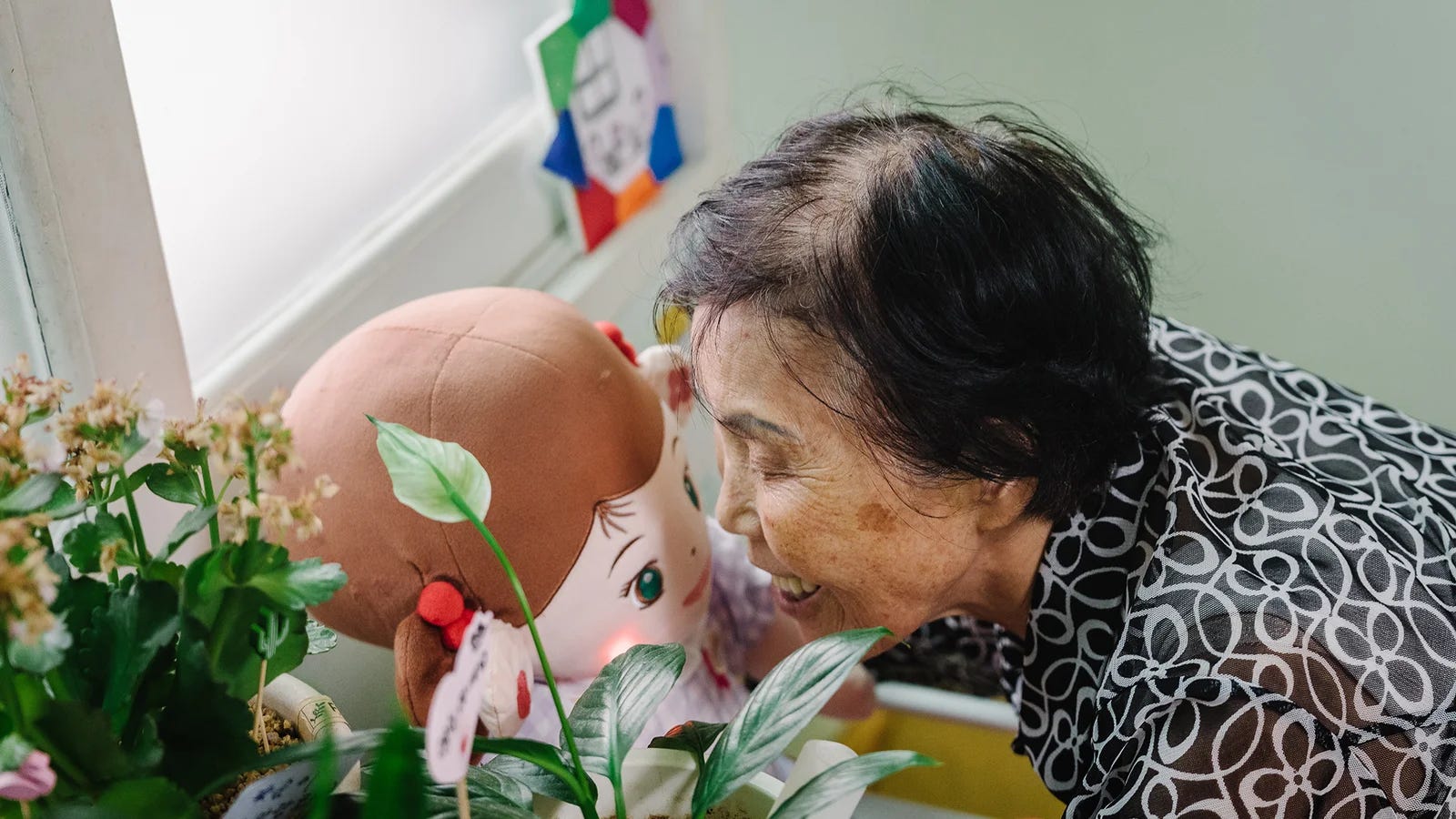
In a welfare center in the Guro district of Seoul, a 78-year-old woman named Kim Jeong-ran cradles a small doll-shaped robot in her arms.
“Grandma, I miss you even when you’re by my side,” the robot says in a chirpy voice.
Kim’s eyes fill with tears. Not from sadness. From recognition.
She lives alone. Her children live far away. Before the robot arrived, she told the social workers at her center that what she feared most was not death. “I’ve lived long enough,” she said. What she feared was the silence. The days that passed without anyone speaking to her.
That robot is called a Hyodol. It is named after a Korean word rooted in the Confucian tradition of caring for one’s elders. As of late 2025, more than 12,000 of them have been placed in the homes of elderly people living alone across South Korea.
And South Korea is not alone. Half the world is watching.
The Problem No One Has Solved
By 2030, one in six people on earth will be over the age of 60.
That is not a projection from a fringe think tank. That is the World Health Organization. And the implications are staggering, because the number of people who need care is growing much faster than the number of people trained and willing to provide it.
Japan is the country furthest down this road, and it has been for decades. Today, nearly 30% of Japan’s population is over 65. The baby boomer generation, every last member of it, turned 75 by the end of 2024. The number of babies born in 2024 fell for the ninth consecutive year to a record low of 720,988. And in the nursing sector, there is currently one job applicant for every 4.25 available positions.
To put that in concrete terms: Japan estimates it will need 2.72 million care workers by 2040. Right now, it is already short by 250,000. By 2040, that gap is projected to reach 570,000.
South Korea is not far behind. Neither is Germany, Italy, China, or dozens of other countries where birth rates have fallen and populations have aged. This is not a Japanese problem. It is a human one.
So for the past two decades, Japan has been running the world’s longest and most intensive experiment in robotic caregiving. And the rest of us owe it our full, honest attention.
What Japan Has Actually Tried
The robots Japan has tested fall into two broad groups.
The first group handles physical tasks: lifting patients, assisting with movement, helping people get in and out of bed, monitoring sleep, and detecting falls. The second group handles something harder to define: companionship. Social engagement. Emotional presence.
Both groups have run into problems that the brochures did not mention.
Take the lifting robots. In theory, a device that can help a caregiver move a patient eliminates one of the most physically demanding and injury-prone tasks in elder care. In practice, researchers doing fieldwork in Japanese care facilities found something different. The robots needed to be moved, assembled, cleaned, charged, operated, explained to residents, and monitored during use. The setup time alone often exceeded the time it would have taken a human to simply do the job.
One device, a lifting robot called Hug, was abandoned by staff after just a few days.
The social robots produced stranger results. Paro, a soft robotic baby harp seal developed in Japan and used in care settings around the world since 2003, generated some genuinely encouraging data. A review of 29 studies found that residents who interacted with Paro showed reduced negative behaviors, better social engagement, and improved mood. A 2022 review found that it could improve the quality of life for people with dementia and reduce their need for calming medications.
But the same fieldwork that produced these numbers also produced this: one resident kept trying to skin the seal. Another became so attached that staff had to carefully manage every interaction to prevent distress. Boredom set in after a few weeks. And a 2020 Japanese study concluded that some communication robots might actually increase stress levels in certain people with cognitive decline.
Despite two decades of government investment, a major national survey found that in 2019, only 10% of care institutions in Japan had introduced any care robots. Many of the robots that were introduced ended up stored in cupboards.
What South Korea Is Getting Right (and Wrong)
South Korea’s approach has been different, and some of what they have found is worth paying close attention to.
The Hyodol robot is not a humanoid. It does not try to replicate a human caregiver. It is a small, friendly-looking doll that sits in your home, talks to you, reminds you to take your medication and eat your meals, and calls for help if you stop responding. At around $1,200, it costs a fraction of most medical-grade robots.
Its AI monitors voice patterns and can flag concerning language, including statements that suggest suicidal thinking, to a social worker. It has been credited with preventing deaths.
The people who use it say things that are harder to quantify but just as real. “There are things I can’t tell my children,” one woman said. “But I tell Hyodol.”
But the social workers are honest about what it cannot do. Some seniors have become more homebound since the robot arrived, not less. Because something cheerful greets them at the door, they venture outside less often. Managing the devices, teaching seniors to use them, and troubleshooting problems have added new tasks to already overworked schedules.
What You Can Actually Buy Right Now
Here is what most coverage of care robots misses entirely. You do not need to be in a government pilot program in Seoul or a research hospital in Tokyo to have access to a robotic companion. A quieter, simpler, and far more affordable version of this technology has been available for years, sold on Amazon, purchased by hundreds of thousands of families, and quietly doing something real for people who are lonely, isolated, or living with dementia.
The best-known brand is Joy for All by Ageless Innovation. Their line includes three types of animals, each responding to touch and sound with lifelike movements and noises.
The Companion Pet Cat blinks, purrs, meows, and responds when you stroke its fur. It costs $124.99, has over 12,200 reviews on Amazon, and holds a 4.4-star rating. If a cat feels more like you, the Silver and White version is also available at $159.74.
The Companion Pet Golden Pup barks, pants, wags its tail, and turns its head when it hears your voice. It costs $177.47 and has over 5,100 reviews. One Amazon reviewer wrote simply: “Bought this for someone with dementia and they loved it from the start. It reacts to their voice and touch and has brought laughter back to them.”
For something lower cost and less demanding of space, the Walker Squawker Bluebird clips onto a walker or sits on a surface, chirping and responding to touch. At $54.65, it is the most accessible entry point and currently carries Amazon’s Choice designation.
A newer option worth knowing about is the Chongker Interactive Companion Robot Cat, a handmade weighted plush that purrs, responds to voice, and simulates a heartbeat. It costs $79 and holds a 4.6-star rating. The added weight makes it feel more substantial in your lap, which some users find more comforting than the lighter models.
At the higher end of the consumer market, a company called Tombot is preparing to release Jennie, a robotic Labrador retriever puppy that won Best Age Tech at CES 2026. After nine years of development, Jennie is powered by nine servo motors, responds to touch sensors across its body, uses a microphone array to hear you, has a light sensor that prevents it from barking at night, and connects to a companion app that lets you give it a name. It is designed specifically for seniors with dementia, intended to sit on a lap or chair rather than the floor to eliminate fall risk. It will cost $1,500.
None of these are PARO. None of them are Hyodol. They do not monitor your health, alert anyone in an emergency, or carry on a conversation. But that is not what they are for.
What the Research on These Pets Actually Shows
The evidence behind consumer robotic pets is more robust than most people realize.
A review of more than ten studies on Joy for All products found consistent results: reduced anxiety and agitation, improved mood, lower use of psychotropic medications, decreased episodes of delirium in hospital settings, and reduced burden on family caregivers. In a pilot program run by the New York State Office for the Aging, 70% of participants showed a decrease in loneliness after one year of using the pets. A Florida Atlantic University study found that 67% of participants showed improvement in MMSE scores, the standard clinical test of cognitive function.
In February 2026, Sarasota Memorial Hospital published the results of a year-long randomized clinical trial, one of the first of its kind in a US hospital setting. Older patients with mild to moderate dementia who received a robotic pet in addition to standard care experienced fewer drops in blood pressure and heart rate, fewer episodes that led to fall risk, shorter hospital stays, and a significantly higher likelihood of returning home rather than to assisted living or skilled nursing care after discharge.
Those are not trivial outcomes. Shorter hospital stays and returning home instead of a care facility are among the most consequential differences in an older person’s life.
The honest limitation is this: these pets are not a substitute for human connection. They work best as a complement to it, filling the hours when no one else is there, providing something warm and responsive in a quiet room. As one researcher put it, they offer “unconditional presence.” That is a real thing, even when the presence is manufactured.
The Robot That Is Coming Next
At Waseda University in Tokyo, a team funded by the Japanese government is developing a 150-kilogram humanoid robot called AIREC.
AIREC can help a person sit up. It can help put on socks. It can cook scrambled eggs and fold laundry. It can carefully roll a person onto their side to prevent bedsores.
It will not be ready for actual care facilities until around 2030. Its initial price will be approximately $67,000.
The researcher leading the project, Professor Shigeki Sugano, is careful not to oversell it. “Humanoid robots are being developed the world over,” he says. “But they rarely come into direct contact with humans. Once humans enter the picture, issues like safety and how to coordinate a robot’s moves with each individual spring up.”
A care worker at one of the facilities testing current-generation technology said something that has stayed with me: “I don’t think robots can understand everything about nursing care. Robots and humans working together is a future I am hoping for.”
The Question Worth Asking
I want to be honest with you about what all of this means.
The story of care robots is not a story of failure. It is a story of a problem so large and so urgent that people have been reaching for solutions before the solutions are fully ready. Japan did not develop these technologies because of indifference to its elderly population. It developed them because the alternative, telling millions of aging people that there will simply not be enough human hands to care for them, is not acceptable.
The research tells us that robots, in their current form, are genuinely useful in specific situations. For a person with dementia who is agitated and responding to nothing else, a few minutes with a robotic pet may do more than medication. For a person living alone who has not spoken to another human in three days, something warm and responsive in their lap, even at $125, may be the thing that quietly holds their mood above the waterline until the next visit from a real person.
But the research also tells us something uncomfortable. The expensive technology being marketed as a solution to the caregiver shortage is not yet solving it. In many cases, it is adding to the workload of the human caregivers who remain. And the question of what we are actually providing when we give a lonely 78-year-old a robot to talk to instead of a person, that question has not been answered. It has barely been asked.
The world is not going to solve its caregiver shortage by building enough robots. Not by 2030, and probably not by 2040. What it might do is build robots that protect the dignity of older adults while we work out how to value the humans who care for them.
Japan and South Korea have given us 20 years of evidence to work with. The least we can do is look at it honestly.
And in the meantime, if someone you love is spending too many silent hours alone, a $125 cat that purrs when they reach out to stroke it is not nothing. The research says so.
What do you think? Would you want a companion robot in your home? Or does the idea feel like the wrong answer to the right question? Share your thoughts in the comments below.


Cute idea, but there is nothing like Grandma 👵🏼! I promise ♥️☘️